

Genre: First-Person Shooter (FPS)
Developer: Trepang Studios
Publisher: Team17
Release Date: October 2, 2023
Players: Single-Player
Review Date: May 21, 2025
Format: Windows, Xbox Series S/X, PlayStation 5
Playtime: ~10 hours
MSRP: $29.99 (Steam)
The First-person shooter (FPS) genre is one of the most established genres in the industry. Due to it’s long-standing history and tradition, it’s sometimes hard to create something innovative and groundbreaking. As a result, we get many releases like the yearly Call of Duties that play exactly the same as the last several before them.
Though some newer games might have a cool mechanic or feature here and there, many end up devolving into a “shooting gallery”. Enter Trepang2. While this FPS doesn’t exactly break new ground, it retreads old ground with a fresh and fancy set of tires. Trepang2 borrows mechanics from some of the most critically acclaimed FPS games and puts them to work within modern hardware to great effect.
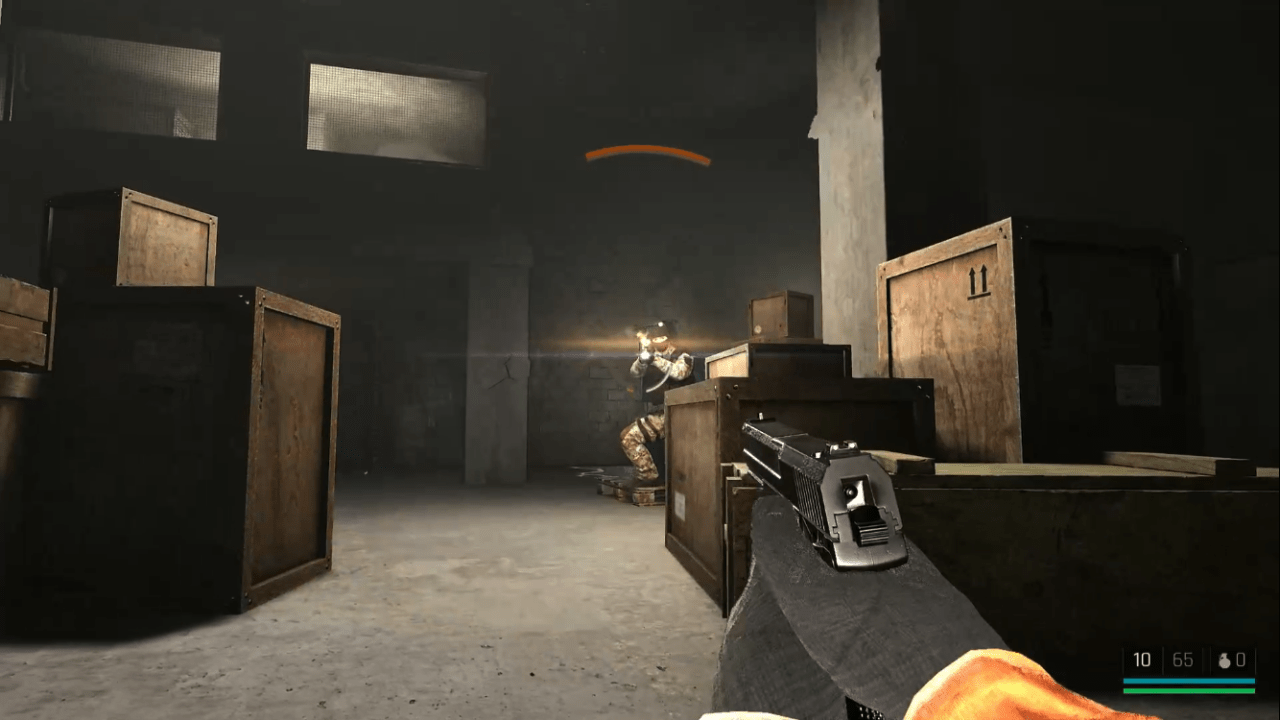
But just how does this indie FPS compare to today’s mainstream titles? We’ll just say it compares, but with some room for improvement.
Gameplay: 2
Developed by the very small Canadian-based studio Trepang Studios, Trepang2 is quite possibly one of the best FPS games I have ever played based solely on its gameplay. The gunplay specifically is, in two words, deeply satisfying.
Firing a combat shotgun into a crowd of bloodthirsty mercenaries hellbent on bringing you down has never felt as good as it does in Trepang2. It is responsive and realistic, for the most part. I say for the most part because for all the cool mechanics this game features, one critical feature is missing. Wait for it… You cannot aim down the sights on any of the guns with the exception of scoped rifles. Seriously? As good as the gameplay in Trepang2 is, why would the devs leave this out? Was it too resource-intensive? Surely not. Most FPSs I have played, especially in recent memory, have included this feature. Maybe I’m just being a stickler, but when actually firing a gun in real life, it’s absolutely critical to aim down the sights so you can precisely hit what you’re aiming at.
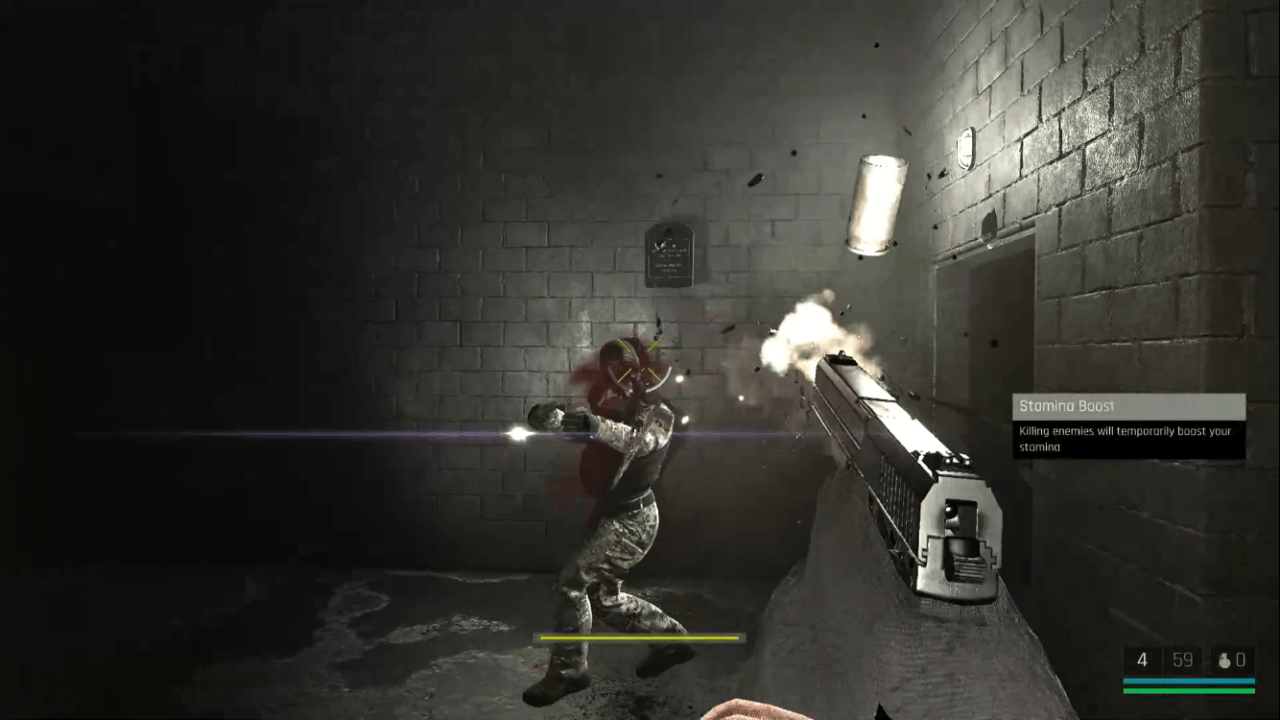
Despite the obviously glaring omission of aiming down sights, it surprisingly didn’t get in the way of my enjoyment of the overall experience. One way Trepang2 compensates for the lack of this basic feature is the existence of the player character’s heightened reflexes. These heightened reflexes come in the form of the powers “Focus” and “Cloak.”
With “Focus”, players are able to slow time down to gain a tactical advantage over the platoon of enemies descending upon them. The “Cloak” ability allows the player to turn invisible briefly, allowing for a quick escape to regroup or plan a hastily improvised ambush. Both of these abilities are incredibly fun to use. The meters for these abilities regenerate quickly enough so the player can constantly use them throughout a protracted firefight. While using “Focus”, it feels almost like we’re playing an unreleased sequel to F.E.A.R. or a first-person Max Payne, which will suffice for many of those who enjoyed those classics to fork over their hard-earned cash.
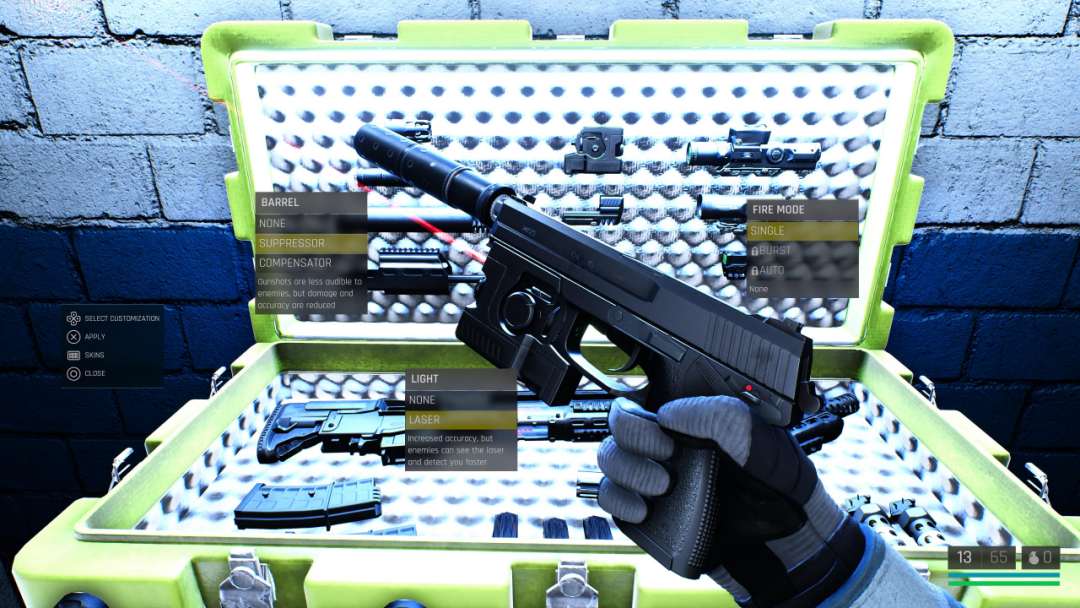
The weapon catalog here is on the smaller end, but each weapon is fun to use at most points in the game. There’s a pistol, submachine gun, shotgun, assault rifle, sniper rifle, minigun, grenade launcher, and a unique explosive bolt launcher that fires in a three-shot volley. The subsequent DLCs added a magnum revolver, a light machine gun, and last but not least, a katana.
Fans of mainstream shooters will immediately recognize some of these weapon models, which only adds to the enjoyment. For example, the sniper rifle is inspired by an H&K SL8, which is known as the “Semi-Auto Rifle” or the “Stingray” in Resident Evil 4. In addition, the submachine gun is, without ambiguity, a KRISS Vector. Anyone who played a modicum of Call of Duty: Modern Warfare 2 back in 2009 will remember this gun and how it was an absolute buzzsaw in that game. Here in Trepang2, it’s probably even more satisfying to use than in Call of Duty. The Vector absolutely shreds through enemies and can be the most effective at wiping out an enemy squad in many situations. Eventually, the player finds a “Serum” that allows them to dual-wield most weapons. I don’t feel the need to elaborate beyond indicating that dual-wielding exists in the game because it’s perhaps one of the most universally beloved features of the FPS power fantasy.
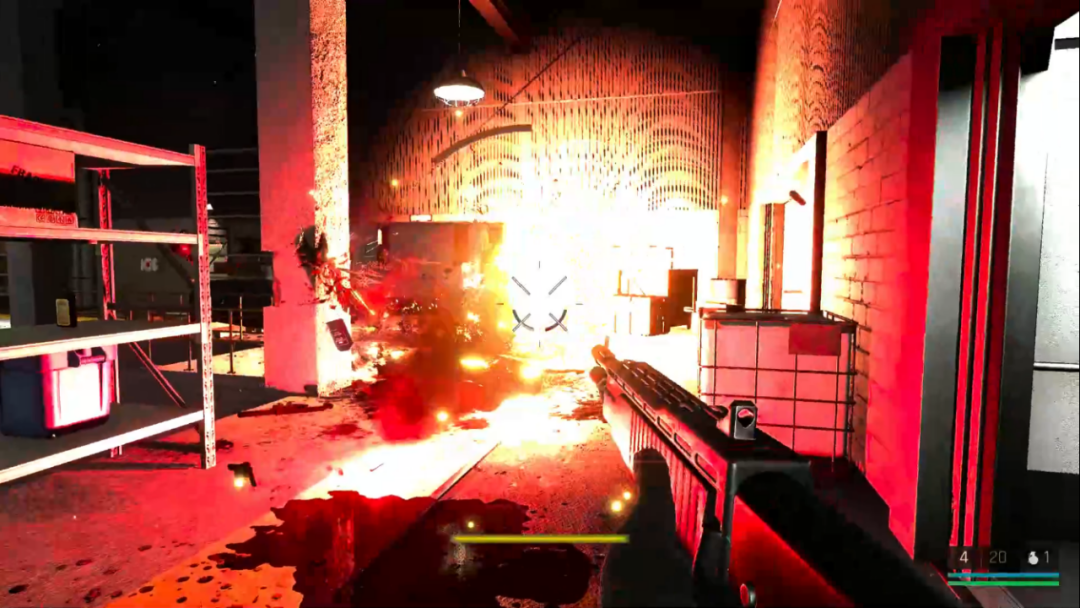
Several kinds of grenades exist within Trepang2, adding another tool to your toolkit for confronting the overwhelming odds against you. The usual suspects are here: frag grenades, incendiaries, impact grenades, and flashbangs. The explosion effects are great, perhaps too great, as I needed to crank the SFX volume down to almost nil to avoid shellshock (Sony soundbar FTW). There’s a few unique grenade choices too, one such being the ominously named “Vortex grenade”. This thing is awesome. Throwing it will initiate a small black hole that sucks any of the weaker enemies into its vacuum and absolutely rips them apart.
There’s also some more Call of Duty member berries in the form of throwing knives and tomahawks. Though I didn’t find these very fun to use, as they were missing a key feature that tomahawks and throwing knives had in Call of Duty. Much like the absence of aiming down the sights, you aren’t able to fine-tune your aim with these weapons. Instead of being able to hold the throw button down and release when you’ve got a bead on your target, the player character simply throws the knife out upon pressing the throw button. The absence of being able to precisely aim these weapons makes them a waste of your throwable slot, especially when the aforementioned vortex grenades exist.
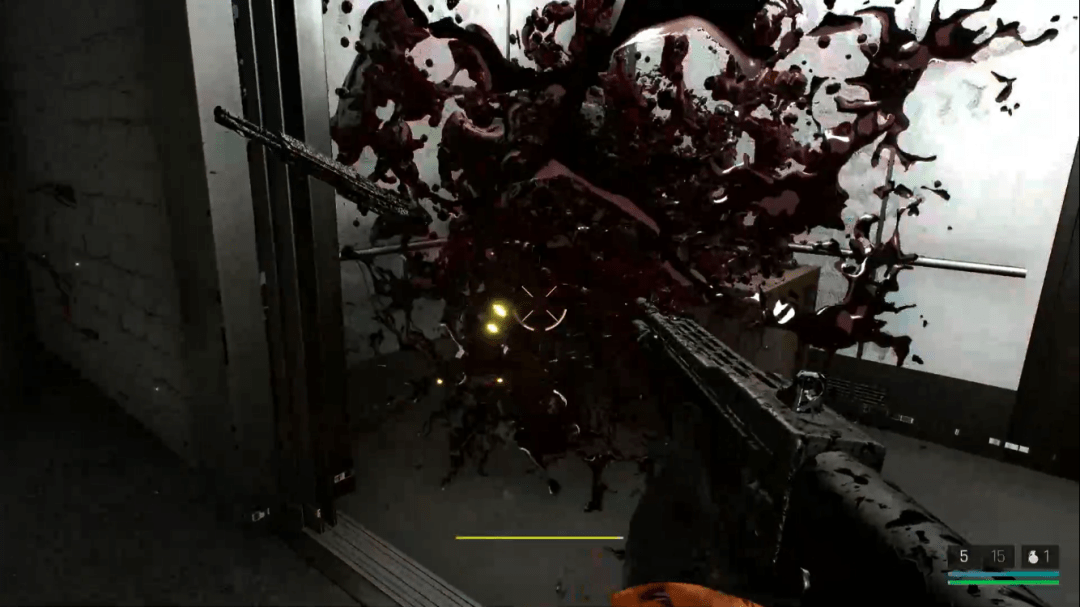
Speaking of explosions, the environments here are fun to wreak havoc in. Throwing a grenade near a wooden table means the ensuing explosion will send large chunks of splintered wood hurtling through the air. These instances provide some really cool visuals, especially in “Focus” mode. Not only will inanimate objects explode into a million pieces, but enemies will too. This game is gory, and that’s almost an understatement. Traumatic amputations are par for the course against enemies, especially when using grenades or the more high-powered weapons, adding to the overall satisfaction the gunplay provides.
“But, Houston! Won’t I want to try and employ stealth at some points in the game?” Well, sure. The bones of stealth combat are here, but it quickly devolves into the standard raucous shootout the second an enemy suspects you’re in the vicinity. There’s a detection indicator on the HUD a la the Far Cry series, but this really only serves as a traffic light that tells the player “GO, GO, GO!” more than a means of avoiding detection. I would’ve liked to have seen more true stealth segments in the game, especially considering the fact that throwing knives, tomahawks, and suppressors exist. Really, the only concrete stealth segment is at the beginning of the game, where the player doesn’t have a weapon and must avoid the horde of armed baddies searching for them. This only lasts a few moments, as the player secures their first weapon shortly after beginning the first mission.

Enemies mostly consist of generic clandestine mercenary types. The enemy AI is rather advanced. Squads will communicate with each other in real time and employ advanced tactics like suppressive fire and flanking. They’ll even call out to their buddies to confirm their status after a hail of gunfire rips through them. One such moment occurred when there was one man left standing among the carnage.
“Dave?! You there?!” He called out before cursing his situation. This was a great detail that reinforces just how imposing and powerful the player character is in Trepang2. Enemies know you’re a great threat, and they will react to you accordingly, from their tactics right down to their last words.
Enemy types range from lightly armored enemies to more tactically ‘kitted out’ ones you’ll encounter as the game progresses. There’s a large roster of “High Value Targets” that act as the miniboss and boss encounters. These are usually more heavily armored versions of the enemies you’ve already been laying waste to. The additional challenges these boss fights provide are meager, save for an even more heavily armored enemy to contend with, along with supplemental mobs of the lower-tier enemies.

Progression consists of navigating through main missions with various objectives, from recovering MacGuffins to locating and terminating (or rescuing) VIPs. There’s also several side missions that act as rudimentary tower defense sequences where the player must hold out and defend a server while a hacking device goes to work.
The first few moments of the game feature against-all-odds firefights against these generic paramilitaries. About midway through the second mission, however, the game throws the player an absolute curveball in the form of zombies and a large, demonic, mutated bat. I was incredibly surprised by this pivot, but it was a nice break from the standard procession of armed mercenaries.
The AI of these zombies, however, is dreadfully simple compared to the human enemies. Remember how in Call of Duty: Zombies, one player would work to get the zombies lined up into a ‘train’ to make them easier to mow down? Yeah, well, the zombies encountered in Trepang2 will just do that for you. They attack the player in a single file as if the consciousnesses of their former human selves are just begging you to release them from their flesh prison. The large, mutated bat encounter was kind of a sticking point for me early on, as he has one of those incredibly broken grab animations that deletes half of your health if it manages to get in your general vicinity. Honestly, this boss fight with ‘Mothman’ as he’s known in-game made me put the game down for a while because it seemed so unbalanced.
Despite a few quirks here and there, the gameplay still receives top marks from me simply because of how much fun it is outside of those few moments. The instances where the game falls short are brief, and it feels like you’re rewarded for sticking with it. For example, the mission immediately following the Mothman encounter features one of the most fun sections in an FPS. This ensuing mission features a crazy shootout throughout a medieval castle teeming with gun-toting, masked cultists. All in all, the gunplay coupled with the special abilities and amazing effects creates a must-play experience for any fan of the FPS genre.
Story: 1
What story? Who cares? I have big gun that make big boom and I kill many bad guy with it, right? Slow-mo mode and SMG go BRRRRRRRRR. Okay, yeah, fine there’s a story but it’s really nothing to write home about.

You play as “Subject 106,” a silent, amnesiac, genetically-enhanced super soldier who has been the subject of various experiments by a shadowy organization. Why are we globetrotting and turning every location we visit into a finely ground powder? Well, Subject 106 is “rescued” from a black site by yet another shadowy organization known as Task Force 27. Their goal is simple: to bring down the multinational pharma/tech conglomerate known as Horizon.
Horizon is one of those big megacorps that casually employs thousands of armed goons to protect its various assets and projects around the world. Eventually, the player discovers *GASP* Horizon is actually doing unethical experiments on people that have led to some absolute catastrophes. 106 oftentimes finds himself showing up at these locales after the initial ruination of the facility has occurred.
There’s not much to spoil here, so I won’t feel bad telling you much about it. Eventually, 106 discovers *GASP* Task Force 27 isn’t being completely up front with him about everything, eventually leading to a double-cross that initiates the endgame.

An alternate ending is available if the player locates all of these various drones that will appear throughout the game, but that’s really it for the story. Again, nothing really to write home about, but the beauty of it is: it doesn’t have to be. That’s right, I’m more than willing to give an indie shooter developed by a team of four people the benefit of the doubt. Obviously, they don’t have the budget for a Coen Brothers-caliber plot, but the slick gameplay alone was more than enough to compensate for the lack of a story.
There was once a time when developers could not have cared less about how deep and engaging the narrative of a game was. We used to be happy if the game even worked, and the gameplay was engaging enough to occupy our time for longer than an afternoon. Don’t get it twisted, I enjoy a great story in a game as much as the next feller. I think, however, we’ve become spoiled with a lot of these great narratives that have appeared in games and especially FPS in more recent years.
A Hollywood movie-grade story requires much more time and resources in addition to creating a fun interactive experience. This expectation can be a tall order for many indie devs. I think we shouldn’t necessarily hold games to as high a standard as movies since the story is, at times, tertiary to a videogame’s overall experience.
Atmosphere: 1
The atmosphere of Trepang2 is absolutely amazing at certain points. It falls short in a myriad of ways too. To start off with some praise, the sound design of the guns, explosions, and other various clicks and beeps are all great. The sound upon entering “Focus” mode is a beautiful cacophony reminiscent of the bullet time scenes in The Matrix. As I said earlier though, the sound effects might be a little too good in that they often obscure dialogue and music.
Sometimes, though, it’s not the worst thing to have the music obscured. This soundtrack sucks. It’s just so generic. There’s nothing really cool or innovative here in the way of a score. Most of the music consists of really intense metal tracks, hardcore EDM, and something I would like to call Harry Gregson-Williams-core. You know what I mean. That generic, not quite orchestral but not quite electronic score that you hear in a lot of mid-late 2000’s movies, games, etc?
You know how it can get really corny and be the exact opposite of inspirational? This is a little bit of what we’re dealing with here. I’m a fan of all kinds of music, but the music in this game is just annoying at certain points. In fact, the score was an active hindrance for me several times. One such moment occurred during the aforementioned section with the zombies. My handler was giving me my next objective over comms while these moaning shamblers and this incredibly overwhelming score were both simultaneously assailing me. As a result, I missed the orders my handler gave me to grab and throw the zombies into these reactors to overload them. As a result, I was aimlessly running around this large laboratory area killing scores of the infected for what seemed like an hour. At first, I thought the game was bugged or something, so I reloaded the checkpoint and caught the 2pt font subtitles of my handler’s dialogue where she instructed me to throw the zombies into the reactors.
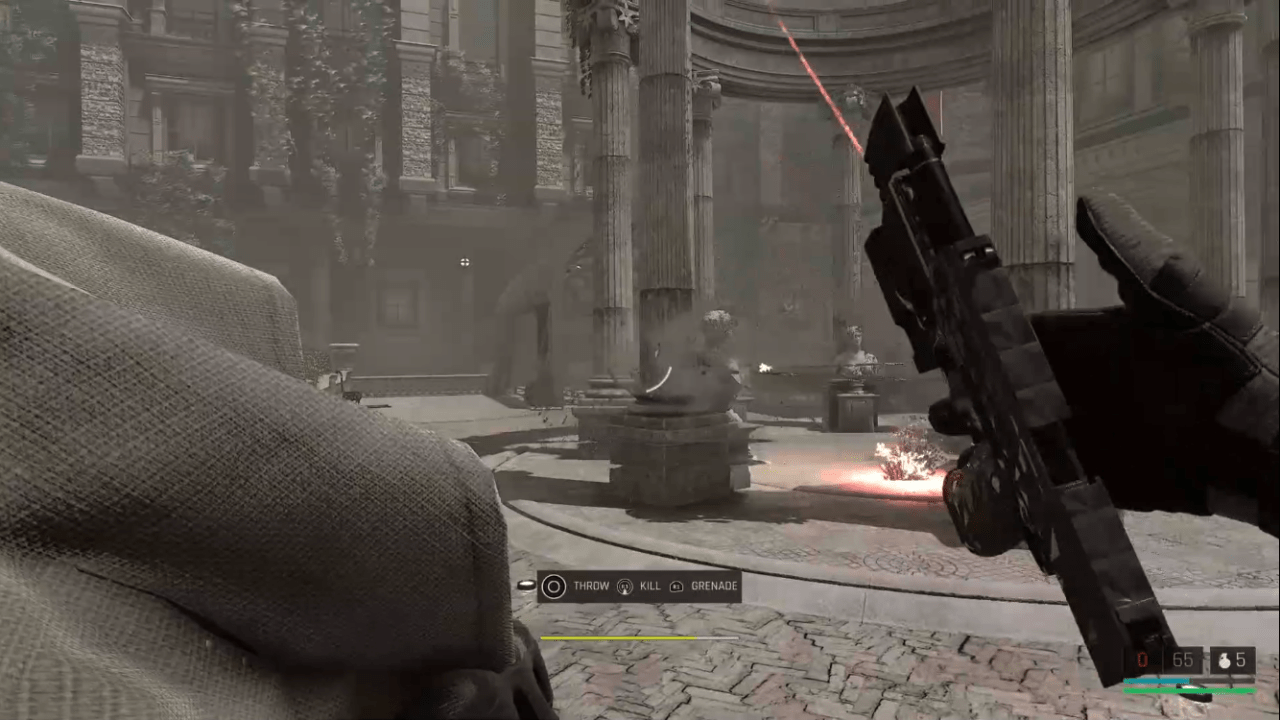
The environments start off as concrete and steel secret labs and medical facilities, with really little to distinguish them from other games built within Unreal Engine 4. If you hang with the game though, dear reader, you’ll be rewarded with some really cool set pieces. I mentioned it earlier, but the level set in the medieval castle is well worth trudging through the initial generic environments. There’s something just so inherently cool about blasting through an ancient building with modern weaponry that is hard to really put into words. Honestly, this castle mission almost felt like a call-back to Namco’s Time Crisis, a late 90s, cover-based light gun shooter that takes place around a European castle. Oldheads will know what I’m talking about.
There are also some moments where tonally, the game takes a huge shift to a psychological horror or thriller, much like the F.E.A.R. games of the past. These tonal shifts from a high-octane military shooter to a pseudo-survival horror environment are surprising and welcome departures that keep the gameplay fresh. I’ve already mentioned the zombie level, but it bears repeating for the purpose of atmosphere. For several minutes before the zombies actually appear, the game leads you on this maze through an underground medical research facility, complete with the aftermath of brutal carnage that occurred sometime before you arrived.
Large bloodstains, dead enemy soldiers, and body bags litter this area, but you can also find written messages on the walls throughout the facility where the guards were trying to coordinate and regroup to deal with whatever mishap occurred here. It’s little moments like these that are so great, it makes me wish the devs had a bit more help financially or manpower-wise to really flesh out some of these bland areas.

Speaking of bland areas, when 106 returns back to Task Force 27’s base between missions, there are no NPCs walking around this humongous area. There’s plenty of furniture and other assets placed around the area that make the place look believable, however, the only person you can have some semblance of interactions with is the quartermaster. Even then, he’s standing behind a bulletproof pane of glass and never moves. The only times he interacts with the player are right before they depart on a mission with a pithy remark about what they’re about to go up against. I guess this is just another con of having such a small team at an indie studio. Trepang Studios probably would have populated these areas if they could. Not exactly a game-breaking issue, but one that is obvious nonetheless.
All in all, the atmosphere of Trepang2 gets so close to being great at times, but is so far away at others. As a result, sometimes the aesthetical disappointments can overshadow the triumphs.
Value: 2
At $29.99, why aren’t you buying this game right f****** now??? Concord didn’t even last two weeks on the PlayStation Store, and it was ten bucks more expensive. Just ponder that for a moment. Okay, now go out and buy the damn game.
If you’re a fan of FPS games in any capacity, you will absolutely love this game. Trepang2 constantly goes on sale as well if you can’t be bothered to pay full price for something like this (which is understandable). You can pay closer to the price of a full game for the Complete Edition that features all the DLC added post-release.
This DLC isn’t a cheap cash grab, however. The amount of content added effectively doubles the runtime, so I don’t think it’s necessarily a bad thing in the case of an indie developer to have these two separate editions. If you love this game, give the indie devs more money so they can continue to create more great games, right? Though some people might have reservations about having to pay extra money for a 20+ hour experience in general. Despite the reservations one might have, it’s not like you’re filling the coffers of the likes of EA or Ubisoft.
Duration: 1
With only six main story missions in the entire campaign, Trepang2 only takes about ten hours to complete. There are higher difficulty levels to complete that give the player better weapon attachments and even cheat codes, but once you’ve beaten the game on the hardest difficulty, what more is there to do?

Though the added DLCs almost double the runtime, you’re going to have to drop a few extra dollars. Such is the climate of the gaming space today. Even still, the fact that people will have to pay more money than the base game costs to get a sufficiently long experience is what keeps the duration from receiving the highest marks. I don’t even necessarily think that making the campaign go longer would have raised the score that much. Perhaps some more diversity among the side missions, apart from the tower defense hackathons, would have bumped this up to a two.
Final Score: 7/10
This article is my second review in a row involving an indie developer with a very small team. I’m constantly impressed by both the creativity and resourcefulness of all these indie developers over the last few years. It seems that indie devs are following the first rule of mass media: GIVE THE PEOPLE WHAT THEY WANT. While, by contrast, AAA devs are busy doing… whatever the hell they’re doing.
So what did you think of Trepang2? Does it invoke the ‘member berries of past greats like F.E.A.R., or is it a blasphemous simulacrum of what came before it? Are you enjoying these reviews of indie games? Let me know!

By Houston Vick

 Off the Shelf Media
Leave a comment