

Genre: Augmented Reality (AR), Massively Multiplayer Online Role-playing Game (MMORPG)
Publisher: Niantic, Scopely
Release Date: July 6, 2016
Players: MMO
Review Date: February 24, 2026
Format: Mobile
Playtime (To Date): Downloaded in 2017
MSRP (To Date): Freemium
We typically do not cover mobile-centered games; however, in recent years, with the advancement of technology, many of the most popular games are found on mobile devices. Combine that with this year’s celebration of Pokémon’s 30th anniversary, we decided it would be best to highlight one of gaming’s most historic titles.
On its release, Pokémon GO became an instant cultural phenomenon, and looking back, it is hard to believe it has already been ten years since its release. Based almost entirely on Niantic’s, now acquired by Scopely, augmented reality (AR) game Ingress, for the first time offered players the ability to catch Pokémon in the real world.
On paper, it seems like the perfect idea for a beloved franchise. It has immediate appeal with the already dedicated fan base, delivered in a package like never before. All in all, it is a good thing, whether the review leaves it with a high mark or not. The AR field is so unique from conventional designs that its design does not necessarily lend itself entirely to being a game. There is a large portion that requires real-world interaction and in doing so removes itself partially from what is expected from videogame theory. It has to blend the two, and while Pokémon GO does just that, it also means some aspects fall short of being a perfect game.
Gameplay: 1
This fall off is immediately represented in gameplay. For those expecting the classic turn-based strategy of Pokémon titles, that is not the experience of this game. Gym battles, whether done cooperatively or solo, are nothing but button-mashing swipe fests. The tactical presence of mind that most of the Pokémon games operate on is not present. Something of a disappointment, especially since that switch from turn-based to real-time had an opportunity for massive success for the franchise, was swapped out for simplicity.
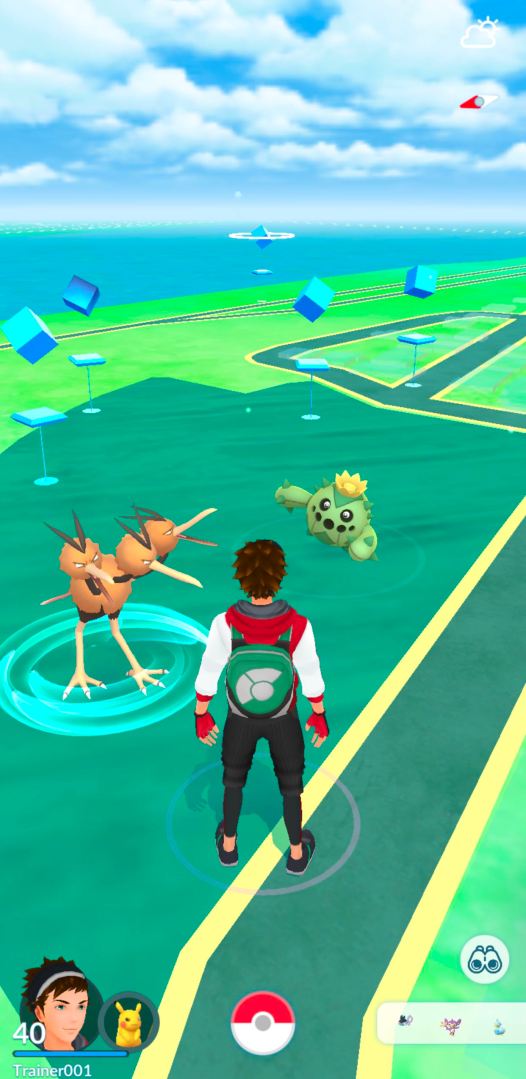
The game feels less about actual battles and more about acquiring Pokémon in general. This feature is the vast majority of the game and is done well. The AR platform tracks steps and movement in the real world, allowing players to see Pokémon appear at random beside their characters and transforming shopping centers and points of interest around them into stops and gyms, although not always done in the best of light. These allow players to ‘battle’ for territory and refill items used to capture and power up Pokémon. Players can also acquire eggs and hatch them in incubators that require players to walk specific distances, or not, if you are dedicated to cheating at a game designed for kids to make walking more interesting.
Story: 1
Following the new modern trend of seasons, especially in free-to-play titles, the game introduces different themes, items, Pokémon, and missions using time-based events. A prime example is finding more ghost-type Pokémon during autumn, or water-based around July. It keeps the game offering something new as well as ensuring there is always something new on the horizon or a better chance to find the Pokémon you may have missed.
It is a mile wide and an inch deep, not necessarily a bad thing, but it lacks the moral imperative that most of the other games have in receiving gym badges. It is enough to keep someone playing, but always optional.
Atmosphere: 2
This is where Pokémon GO really shines. The use of AR brings that feeling of being an actual Pokémon trainer closer to reality than it has ever been. The errors from randomly generated POIs in the real world are obvious; players should always be respectful and aware of their surroundings.

Outside of those shortcomings, it makes gameplay far more worthwhile to discover Pokémon around where you live or discover different types while traveling, even more exhilarating. If the atmosphere were weighted heavier this review would be closer to perfect.
Value: 1
Yes, the game is free, but not without its downsides. There are certainly chances to upgrade your Pokémon and inventory for free, but with most MMOs and especially freemium titles, players are never set up well without coughing up cash. While I have never made any in-game purchases, countless other players, rather understandably, have, and possibly unknowingly, made contributions to other businesses as a result of their gym locations.
It is fair to say you can comfortably play without spending money if you manage your inventory well. It is not a holistically nefarious method of game design, but it does encourage players to spend to make it a bit easier. If you go into the game knowing that, then it is easier to prioritize management ahead of time so you never lose out on specific items and challenges you want.
Duration: 2
This game is about as endless as it can get. It is constantly updated with new events, missions, items, Pokémon, and gameplay mechanics. If you started playing this year after taking a break since the release, most of the game outside of its core systems would be totally unrecognizable.
Total Score: 7/10
It is cliché to say it is more of an experience than a game, but that is what augmented reality is designed to do.
The lack of in-depth gameplay is most likely two-fold. It kept development costs down so it could be released for free, and also does not remove players from experiencing the game environment and the world around them in equal parts. It’s a great game for kids, and I am sure every casual fan of Pokémon downloaded it at some point, and for good reason. Even those who weren’t fans of the franchise could not avoid its cultural impact.

By Nash Moorer


 Off the Shelf Media
Leave a comment