

Genre: Third-person, over-the-shoulder, Survival horror
Developer: Remedy Entertainment
Publisher: Epic Games
Release date: October 27, 2023
Players: Single-Player
Review Date: July 27, 2024
Platform: PS5
Playtime (To Date): ~30 hours
MSRP (To Date): $59.99

Remedy Entertainment, of Max Payne and Control fame, has done it again. Remedy shows with their latest entry, Alan Wake 2, that they continue to be one of gaming’s best storytelling collectives. This game is an absolute achievement in a multitude of arenas; story, graphics, gameplay, voice acting, etc. They all come together beautifully to make one of the best survival horror experiences of the past several years.
That being said, fans of the first game might be in for a bit of a surprise if they were expecting the same high adrenaline, wall-to-wall action of the game’s predecessor Alan Wake. This time, Wake’s journey is supplemented by the investigation of the deuteragonist, FBI agent Saga Anderson. Players are free to swap between the two narratives at certain points, but the game is just as much Saga’s… saga… as it is Wake’s.
Alan Wake 2, much like its predecessor, is not a perfect game by any means. This sequel’s shortcomings come not from technological limitations or drastically changing game mechanics during development. Rather, Alan Wake 2’s problem is it simply tries to do too many things perfectly. As a consequence, there are times when it does many things poorly.
WARNING! Light spoilers for Alan Wake 1 and 2.
Gameplay: 1
For starters, the combat and gunplay are some of the best I have ever experienced in the third-person, over-the-shoulder survival horror subgenre. Someway, somehow, Alan Wake 2 managed to rival the Resident Evil 4 remake in terms of the quality of the game’s combat. Firing Saga’s duty weapon and Alan’s classic revolver just feels right. There is a certain ‘weight’ to every shot you take that reinforces the importance of keeping a close eye on your ammo. This is owed also in part to the game’s great sound design (we’ll get to that) and the incredible haptic feedback capabilities of the PS5’s DualSense controller. Every weapon acquired is unique, offering a wide variety of playstyles that weren’t seen in the first entry.
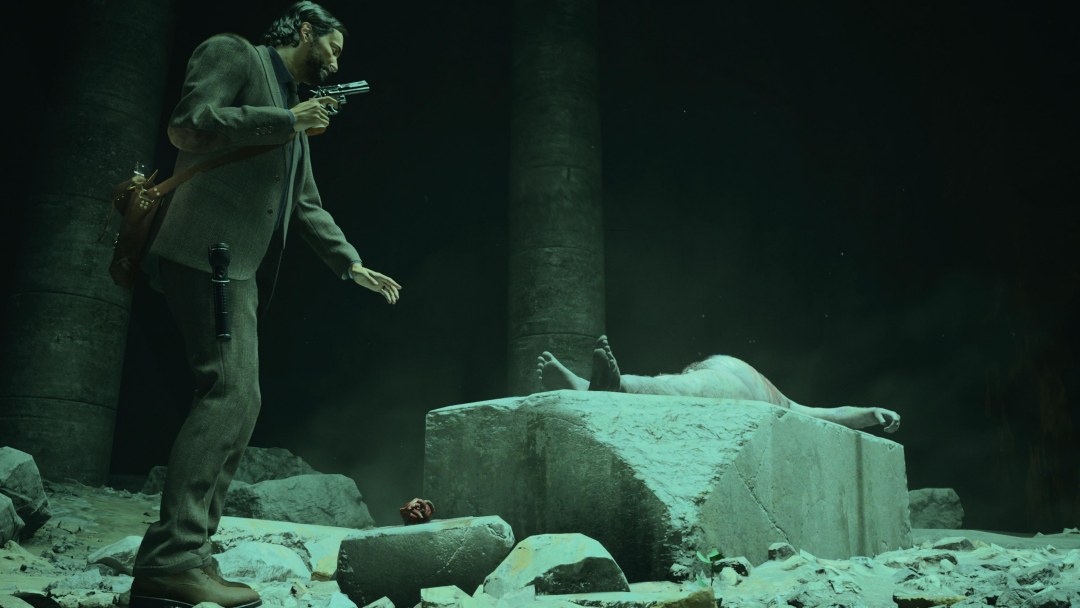
Certain parts where the game ‘opens up’ into larger areas are done incredibly well. One such segment that stands out involves Agent Saga Anderson venturing to the creepy amusement park ‘Coffee World’ while on the trail of the enigmatic Cult of the Tree. There is indeed a ‘rule of three’ puzzle or two found over the course of the game’s 20-24 hours of gameplay, but the game executes this trope uniquely well for the most part. Instead of finding three gems obviously inserted into three similar slots into a door or gate nearby, Remedy provides us with a new twist on this kind of puzzle that won’t be spoiled in this review.
Cauldron Lake, downtown Bright Falls, and the nearby town of Watery are all great examples of the game’s larger open areas that offer many satisfying avenues for exploration and replayability.
Speaking of puzzles, all the riddles and puzzles that are outside the main narrative of the game are all worth doing. They either give the player a much-needed ‘care package’ of supplies or charms that upgrade Saga’s stats and abilities. There was never a time when I went through the effort to solve an optional puzzle and scoffed at the reward for my efforts. This game does a great job of rewarding you, but also challenging you for going off the beaten path. Sometimes, you’ll reach the lunch box or item stash in the far-off corner of the map untouched. As you return back to the main path, the player could be ambushed by the game’s signature ‘Taken’ enemies or something worse.

The enemy variety in Alan Wake 2 is a huge step up from the first entry. In the Alan Wake games, the enemies known as ‘Taken’ are shielded by darkness. This mechanic requires Alan and Saga to ‘focus’ the beam of their equipped flashlight to break through the shield. Only then can the player damage or kill the enemy. Focusing the light expends its battery, which can only be replenished via consumable batteries found randomly throughout the game world. Alan Wake’s enemy types featured burly brutes, shifty rogues, sentient, aggressive construction equipment, harmful dark puddles and a giant instakill darkness tornado.
Admittedly, this is some pretty good variety for a game that’s turning 13 years old. That being said, there were times when the signature violin flourish and slow-mo shots of shadowy lumberjacks descending upon you were more eye-roll-inducing than scary. Further removing from the suspense, large stacks of ammo for all the player’s weapons could be found before just about every large encounter. In this entry, careful management of resources is tantamount to the player’s survival.
Some enemies are formless shadows that can morph into Taken over time. They also can respawn if the player lingers in one area. There were plenty of moments in my playthrough where I had exhausted key resources like ammo or flashlight batteries around these enemies. The ensuing encounter played out as what I would describe as a ‘shadow puppet gang initiation ritual’ where I was thrown around and beaten down by shadows due to the inability to boost my flashlight. This moment was a great lesson to show the players that they would not find batteries and ammo around every corner like in the first game.
The larger, brute-style enemies pose more of a threat than their, mostly annoying, Alan Wake 1 counterparts. Their swings can knock you to the ground, leaving you wide open for a devastating follow-up attack. Intimate knowledge of the game’s dodge mechanic is key when facing these imposing enemies.
During the game’s nursing home segment, I was accosted by a very clearly Silent Hill/Resident Evil-inspired enemy, leaving me nodding with approval when I finally dispatched this unsettling, demonic foe. The game wears the inspiration on its sleeve, which is a nice little nugget for seasoned survival horror genre enjoyers.
The dodge mechanic makes a return from the first game, but it functions more as a last resort than a surefire means of surviving a mob of attackers completely unscathed. It has less range than Alan Wake 1’s dodge, and the threshold for activating the ‘bullet time’ slow-mo perfect dodge is much more strict this go around. I don’t knock the game for this at all, seeing as the health bar is infinitely more consequential in Alan Wake 2 compared to the first entry. Healing via lamp posts like in the first game is only a partial heal at critical health, so light sources only seem to benefit in the most dire circumstances.
Alan Wake 2 features several kinds of healing items that vary in potency and time to apply. Painkillers work immediately and heal a bit over time. Conversely, a full first aid kit requires a lengthy animation but provides a full heal. The healing animations can be interrupted in the heat of battle by overly aggressive foes, so an additional layer of strategy is present in Alan Wake 2 that was absent in the previous entry. Credit to Naughty Dog’s The Last of Us for the implementation of this mechanic. Having to weigh and strategize when and what to use for healing is a perfect detail to add to a game in a genre with the word ‘survival’ in it. Alan Wake 2 takes what The Last of Us pioneered and applies it wonderfully.
Yet, for all the wonderful things this game does, it certainly had its share of moments that induced sighs and head scratches.
One of the biggest weaknesses the game has is how difficult it can be to navigate to the next objective at times. You’ll spend a ton of time investigating one area and walking all the alternative paths to find these side items. What you’ll end up with is literally everything but the item you are looking for.
Sometimes, your next destination couldn’t be more apparent, other times, it is… vague, to say the least. One such instance happens after Agents Anderson and Casey return to Cauldron Lake from downtown Bright Falls-an area with many blocked paths due to flooding during their first visit. The game doesn’t do the best job of showing you that you can traverse this area once it’s open, even though Saga is able to walk through the water on the second visit. Overall, the area was not highlighted sufficiently enough for me to explore.
Another pain point is the map feature, which can be helpful for marking missed items and such but isn’t the best for quickly referencing areas you have explored. To top it all off, bringing up the map does not pause the game. This can make losing your way during a tense encounter deadlier than it has to be without a good way to get your bearings quickly. It’s intended to be a challenge, I’m assuming, but this just ends up being annoying.
I am willing to give the benefit of the doubt when it comes to navigation as it pertains to games with big open areas like this one. When coming up with a new game, the amount of handholding impacts the entire production, so how much is enough? It’s a question I’m sure comes up more often than people think. Do they go the way of games like Assassin’s Creed and inundate the player with a million waypoints on a map and compass? Do they go the route of Ghost of Tsushima and have the wind blow leaves in the direction of the player’s next objective? Do they go the Dark Souls route and place an NPC by a checkpoint that gives you some cryptic monologue in Middle English about where to go next?
Within the gaming community, two groups have stood in opposition: Some want to be told exactly the spot to go and how to get there while others want nothing at all on their screen and to explore every nook and cranny. It must be a real nightmare trying to strike that balance. However, given the capabilities of the engines that exist today, there are plenty of ways for devs to show players where to go without overloading them with visual stimuli. Hopefully in future entries, Remedy makes this issue less nagging.
Story: 2
The narrative is where the game really shines. The detailed graphics and character models are a huge plus, but this is only truly appreciated through the weaving narrative that Remedy has crafted for the player in Alan Wake 2. Players that hunger for a good story will get hooked from the beginning, but there is something here that could intrigue even fans of ‘mindless’ shooters.
I don’t want to spend too much time discussing the narrative for fear that I would spoil the big twists and turns for you, dear reader. You’ll just have to pick up the game. Alan Wake 2’s story is not unlike the sound design: dark, gritty, somber, depressing, and unsettling. It spans the whole range of negative human emotions. That said, the game is not averse to a few pulse-pounding, adrenaline-inducing moments that rival some of the best in mainline action titles. At one point, when fighting through the infernal, Groundhog Day-esque talk show that Wake has found himself in, the game goes full rock musical with epic light shows, dancing, and shredding guitar riffs. Go and buy the game solely to experience the “We Sing” chapter, which you can watch on our YouTube channel to see what I’m talking about.
Wake’s segments are mostly large narrative puzzles utilizing the manipulation of light sources or story elements in Alan’s ‘Writer’s Room’ interactive menu to navigate cryptic mazes. Alan is stuck in ‘The Dark Place’- a hellish dimension where the writer’s narratives come to life and turn on him. Alan must solve these puzzles of narrative and light in order to get back to our reality. These puzzles can be unique and engaging at points, but there were times when I just wanted to be fighting Taken. I didn’t want to be opening and reopening hidden pathways in subway tunnels only to have to be shot back over to almost a completely different story with different characters and different stakes. It’s a fair criticism to make when the game is called ‘Alan Wake 2’ and not ‘The Writer and the Psychic FBI Agent.’

Saga is not a bad character. In fact, I really enjoyed her segments and her ‘Mind Place’ interactive menu for organizing details about the investigation(s) she has throughout the course of the game. My only thing is…why couldn’t this have been its own 30+ hour game? Why did it have to be crudely grafted onto a game called ALAN WAKE? There are times where I was invested in Saga’s journey and what was coming up next for her, but when I got deeper into the story, without revealing too much, she just felt shoehorned in at certain points. Melanie Liburd, Saga’s voice and face in the game, is a great actress with a great voice. I hope with this performance, she continues to be a regular for videogame facial motion capture because she animates very well. My only problem is that her native British accent comes on very thick at certain points which, admittedly, breaks immersion and the believability that the player is in the shoes of an American FBI agent.
Alan Wake 2 is one of the games under the umbrella of the controversial narrative consultation development firm Sweet Baby Inc. The prevalence of a black female lead in a story made primarily by Finnish people with Finnish actors and actresses makes a lot more sense given their involvement. I think imposing diversity and inclusion standards on a game developed in a country that, quite frankly, doesn’t have a lot of diversity because it is a fraction of the size of the US is an odd decision, to say the least.
Saga Anderson could’ve had her own video game with her own story separate from Alan Wake’s and I probably would have loved it. Making Alan Wake share a protagonist spot with any other character regardless of their race or gender is confusing in a game that is literally his name. If Sweet Baby Inc. truly cared about diversity and inclusion in videogames, they would be developing new games with diverse and inclusive characters. Instead, the firm packs diverse characters and messages of inclusivity into established games and franchises. As a result, they cannibalize the narrative they’ve been inserted into at the altar of inclusion. Simply put, Alan Wake 2 is not as good partially because of the additional narrative of Saga it has stapled to it.
One such ‘current day-ing’ the game gives us that made me absolutely cringe was during the lead-up to a boss fight with Taken members of the town of Bright Falls’ local law enforcement. The possessed cops reveal their true nature when the darkness gets a hold of them. In dialogue, they reveal their plan to frame a black tourist couple for a string of murders, followed by derogatory remarks about black FBI agent Saga, referring to her as a “black FBI bitch”.
So, like, we have to kill these guys now because they’re RACIST! It wasn’t bad enough that they were possessed by an entity known as the ‘dark presence’ that turns its victims into violent ghost zombies. Now we have the motivation to dispatch them! I couldn’t have mercilessly gunned down evil demon ghostmen without first being told they were also racist evil demon ghostmen.
Atmosphere: 2
This is one of the most visually impressive games released to this point. Details of trees, rocks, water, light fixtures, buildings, etc. all look incredibly real. Even on a vanilla PS5 with the graphics settings set to ‘performance’ over quality, it is still one of the most photorealistic games I’ve ever played. From carefully crafted and “lived-in” set pieces in Bright Falls to surreal and unsettling destinations like The Overlap and The Dark Place, all of these settings feel incredibly “real” and believable as players traverse the world. The graphical heavy-lifting done by Remedy’s in-house Northlight engine is a big reason why you’ll want to keep playing.

2010’s Alan Wake had no shortage of violence and unsettling to terrifying environments, but its ‘T’ rating means that it couldn’t go very far in the use of violence to convey a unique horror atmosphere. Alan Wake 1’s rating as well as the technological limitations of the time meant that it wasn’t able to delve into areas commonly explored in newer engines like body horror. Alan Wake 2 has an ‘M’ rating, and the differences between the two games in this regard are noticed almost immediately upon starting a new game. There are moments in Alan Wake 2 where the game goes into what I would call ‘Full Silent Hill/Resident Evil mode.’ In these moments, the player follows large blood trails and will find hearts and other viscera scattered along the way. One such segment involves Alan climbing through a derailed subway car full of charred and bloody corpses, which stuck out in particular due to the game’s photorealistic graphical fidelity.

Many of the characters are modeled after real people, and this is shown off beautifully in the game’s engine as well. Characters will look surprised, sad, angry, happy, and so on. The whole range of human emotions is seen throughout the game on the character’s faces. For the most part, these detailed character models only further immerse the player in this world. Eyebrow raises and frowns from certain characters couldn’t help but make me smile and reflect on how far we’ve come so quickly with this technology. Saga Anderson (Melanie Liburd), Alan Wake (Illka Villi), and Alex Casey (Sam Lake) all shine in their animations. Remedy could not have done a better job taking these three from the screen to the console (and back again).
As is tradition with Remedy games, Alan Wake 2 has several live-action segments. These are well-lit, well-shot, well-written, and well-produced to the highest of film and television standards. At points, even during in-engine cutscenes, it feels less like a videogame and more like the latest release on HBO Max. Many of these initial live-action scenes involve a confused and distressed Wake finding himself in a surreal late-night talk show time loop.
In addition to these unsettling, cinema-quality scenes, the player can also come across some hilariously done live-action ‘commercials’ that play on television screens found throughout Bright Falls. Players are encouraged to seek these out as they provide a remarkably placed comedic break from the hefty amount of gloom Alan Wake 2 provides. The quality of animation for the character models, especially Wake’s and Alex Casey’s, means that it isn’t jarring for us to transfer between these live-action and in-engine cinematics and gameplay.
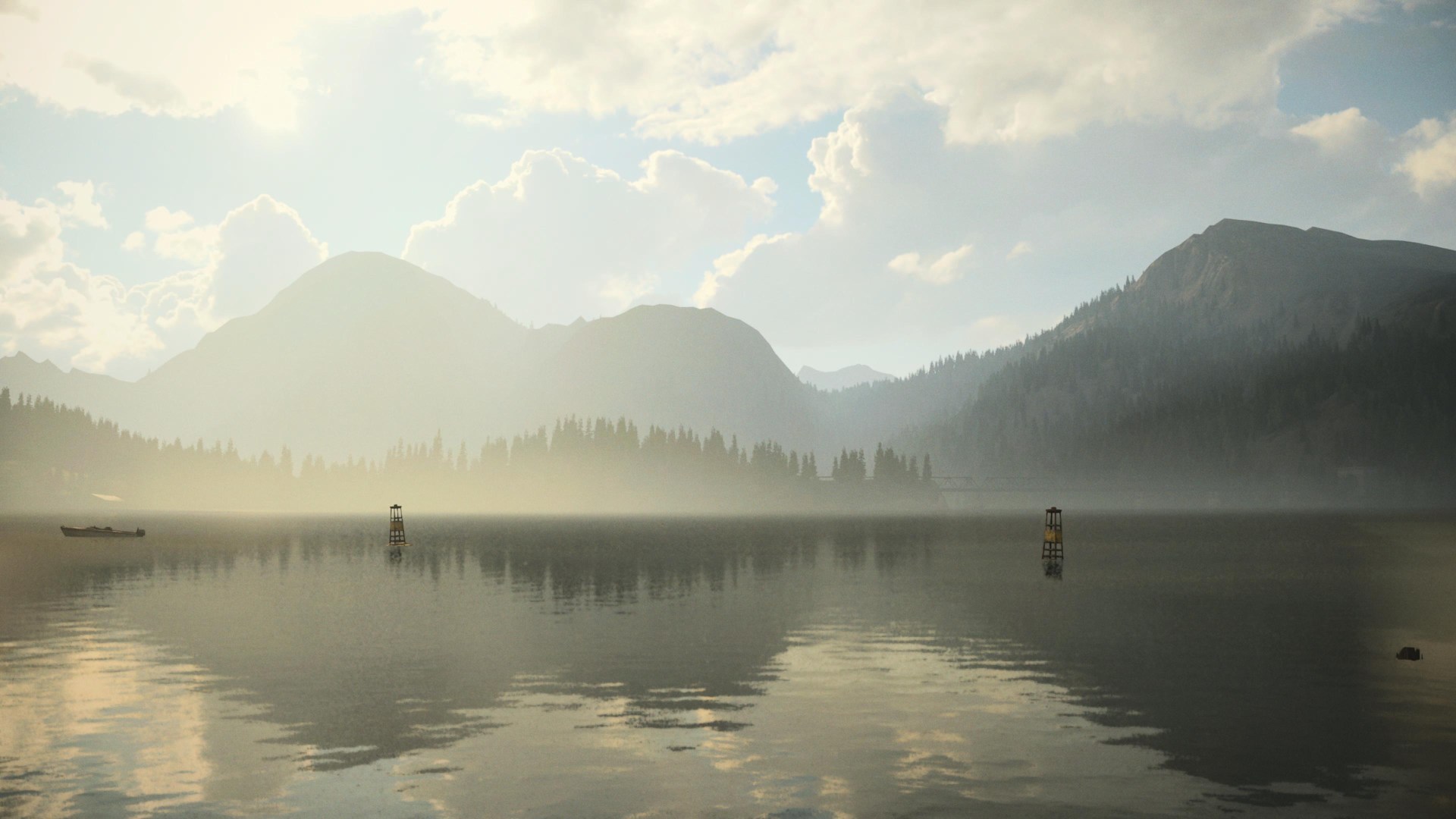
The game’s music, score, and sound design in general are about as good as it gets for videogames today. I loved the tunes that played at the end of every ‘episode’ during the playthrough. There are plenty of creepy, depressing, and sad flavors of ambiance fostered by the score to keep even the most seasoned survival horror veteran’s hair standing on the back of their neck. The sound touches the whole range of negative human emotions, from somber to unsettled to downright terrified. Gunshots, explosions, impacts, splashes, shatters, and punches all feel and sound real, and not like some stock sound file.
Value: 2
Is Alan Wake 2 worth the $59.99 price tag? Most definitely. As more and more games come out with $70 and $80 price tags, unfinished at that, $60 for a full, complete experience is as good a deal as one can get. Also, I wouldn’t say those who didn’t play Alan Wake won’t enjoy this game, but maybe consider picking up Alan Wake Remastered on the PS5 as well if you haven’t. It’s a great time capsule of videogames from over a decade ago, and there’s a certain level of sweet nostalgia I feel while playing the original entry. If you have a PC, consider simply buying the original game released for PC in 2012, as the remastered version is only a slight graphical update compared to consoles.
Duration: 1
One of the other glaring issues with the game is the fact that, for as good as the combat is, how short and few the combat sequences seem to be. Don’t get me wrong, quality over quantity is good, but for as much combat as was in the first Alan Wake entry, I was expecting maybe just a tad bit more combat, especially from Alan’s segments. There were many moments during the game, especially during Alan’s segments where I found myself saying aloud, “That’s it?”
I wanted more. Once I figured out the gameplay loop and how to best dispatch the enemies, I just wanted more of those adrenaline-inducing skirmishes found throughout the first game in this new engine.
I credit this issue partially due to the fact that it was such a high-budget project. Fun fact, it is actually the most expensive project ever exported from the nation of Finland. That $70 million budget didn’t all go into the quality of the game itself necessarily. Because there were so many live-action segments, commissioned music tracks, and established names involved, that money went in a lot of other directions than what a videogame production would traditionally see.
Because of the grand budget’s myriad unorthodox avenues, the game tries to do too many things perfectly. Granted, there are many times when the game completely comes together and flourishes as a true work of art disguised as an interactive experience. However, there are plenty of times when all the moving parts are moving independently from each other, and it doesn’t paint the prettiest of pictures. For example, there is a point in the game where you’ll be in this large, dark, creepy thicket of forest near Cauldron Lake. Creepy music plays, an unsettling aura permeates the atmosphere, and then… nothing happens. All this effort to create such a beautifully dark and spooky moment and you just walk to the objective, pick up the item you need, and walk back to the other objective. Maybe there’s a jump scare or two but there are plenty of such moments over the course of the game that leave something to be desired.
Total Score: 8/10
All in all, Alan Wake 2 is as close to a masterpiece as a game in this genre can get. For all its faults, there is too much to brag about for the shortcomings to really become more than a brief distraction. It has a beautifully crafted story with satisfying gameplay that keeps you mostly engaged from start to finish. Plenty of funny, scary, and cool to satisfy 20-30 hours.

By Houston Vick


 Off the Shelf Media
Leave a reply to Best Non-Horror Movies for Fall – Off the Shelf Media Cancel reply