
Genre: Survival horror, hack-n-slash
Developer: Capcom
Publisher: Capcom
Release: January 25th, 2001 (Original), January 15th, 2019 (HD Remaster)
Players: Single-Player
Review Date: May 22, 2025
Format: PS2, Xbox (Original), Windows, Switch, PS4, Xbox One (Remaster)
Playtime (To Date): 17 hours
MSRP (To Date): $19.99
At a local videogame retailer I frequented as a youngster, ‘M’ rated games were kept higher up on the shelves. This was done for obvious reasons, but every now and then, a box found itself low enough for my younger self to reach. One such fortuitous event is how I was introduced to one of Capcom’s most innovative and acclaimed series in the developer’s history, Onimusha.
I was already a huge fan of TV series like Rurouni Kenshin and Samurai Jack at the time, so the prospect of playing a samurai hero on a quest to save a princess from an army of demons was right up my alley. Flash forward 24 years later and well, it’s still right up my alley. Surprisingly, even with newer remastered releases, it still feels the same to play as it did back in 2001. Playing a remaster of an old game, many times, feels like the soul of the game has been taken out in favor of minor improvements. These updated versions can feel like cheap replicas of their progenitors, but this is not the case with Onimusha: Warlords and its remaster.
Originally inspired by one of Capcom’s several magnum opera, Resident Evil, the Onimusha series has since gone on to define itself as a groundbreaking and captivating experience in its own right. Released way back in 2001 originally, Onimusha: Warlords was both a technical and artistic achievement at the time. The game pushed the limits of the brand new PS2 console, as well as took bold risks not yet commonly seen in videogame development to that point.
How well does this now decades old game hold up? Incredibly so. Sit back, relax and let this increasingly old-headed interactive media scholar put you on to one of the best experiences in the history of early 3D console gaming.
Gameplay: 2
In my recent review of Signalis, the gameplay received a one instead of two because of my realistic understanding that not everyone today would find the game’s perspective and control scheme as engaging as some survival horror veterans. Onimusha: Warlords, however, is different. Though the game employs the same tank controls and fixed camera angles of its predecessors, it feels a lot more hectic and fast-paced than the slowly building tension of the Resident Evil series. Seeing as players are a 16th century samurai warrior instead of a gun toting SWAT (S.T.A.R.S.) officer, the differences are clear immediately upon pressing ‘start’.
Players begin with a standard samurai sword. Players attack enemies with the “square” button on the PlayStation controller. Enemy attacks can be guarded by holding the “L1” button, and that’s pretty much the bones of what you’re working with in Onimusha’s combat system. Additionally, players can hold the ‘R1’ button to enter a crouched, ‘ready’ stance with their sword pointed forward to initiate thrusting attacks. While holding R1, the player can also dodge attacks left and right as well.
If the player happens to attack the enemy right before the foe’s attack lands, Samanosuke’s resulting attack will interrupt the enemy’s with a grievous strike. This counterattack is known in-game as an “Issin counter”. An Issin counter will not only instantly kill the enemy attacking the player, it will also regenerate a fair bit of health, adding a risk-reward system to the combat not found in Capcom’s other titles.

Early on in the experience, protagonist Samanosuke Akechi learns that his earthly sword is no match for the various demons he is up against. Thus, a clan of benevolent demons (called “ogres” in the original release’s English translation) grants Samanosuke the “Oni gauntlet.” This gauntlet grants Samanosuke the strength to defeat the hostile demons as well as the ability to absorb their souls. These “souls” are used in various applications. Yellow souls refill Samonosuke’s health bar, blue souls refill Samonosuke’s magic bar, and the most common red souls act as the game’s currency to upgrade Samonosuke’s weapons and magic. Red souls can also be used to upgrade lower-tier healing items and ammo into stronger, more potent versions.
As Samanosuke explores Inabayama Castle, he discovers several ancient magical weapons along with more traditional ones. These magical weapons consist of Raizan, Enryuu and Shippuu. The first weapon found, Raizan, is a lightning-quick swinging katana imbued with the power of, you guessed it, lightning. The next is Enryuu, a sword of fire that swings much slower but hits a lot harder. Enryuu is comparable to something like a greatsword or bastard sword found in other games. The final weapon Samanosuke acquires, Shippuu, is a twin-blade enwreathed in hurricane-force winds.
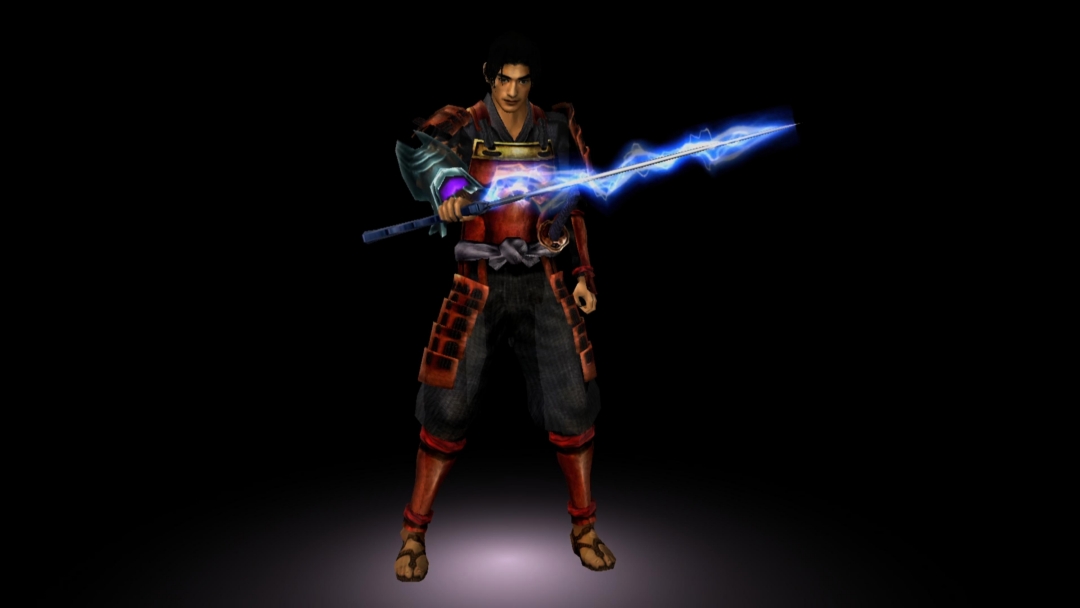
Each of these three weapons has its own unique magical attack that can be initiated with the “triangle” button on PlayStation. These attacks deplete Samonosuke’s magic meter, which can in turn be filled by killing certain enemies, absorbing blue souls, or visiting various shrines containing magical energy.
Despite the historical setting, it wouldn’t be a Capcom survival horror title without any ranged combat options, right? Fear not. Eventually, Samanosuke comes across two different ranged options that allow for him to dispatch foes at a safe distance or strike at ones out of reach. Early on in Inabayama Castle, Samanosuke comes across a longbow, which uses scarcely found arrows. This bow does a ton of damage, but with the old school aiming and tank control system, players might be in for a frustrating experience when attempting to use this method initially.
When players are on the same plane as their enemy, the ranged combat works great. If Samanosuke is above or below his target, your accuracy is going to be about 50/50. Yes, there’s an aim assist but it’s not as snappy as I would like it to be, especially because players have to depend on it to use these weapons. The other ranged option Samanosuke finds is that of a weapon synonymous with the Sengoku era, the Tanegashima matchlock rifle. Overwhelmingly powerful with even scarcer ammo reserves in the game world, the matchlock rifle serves as the great equalizer against the toughest enemies Samanosuke encounters.
The diverse arsenal Samanosuke builds over the course of Onimusha: Warlords is one that is quite vast for a 24 year-old game. All these different options keep the gameplay fresh and engaging for hours upon hours.
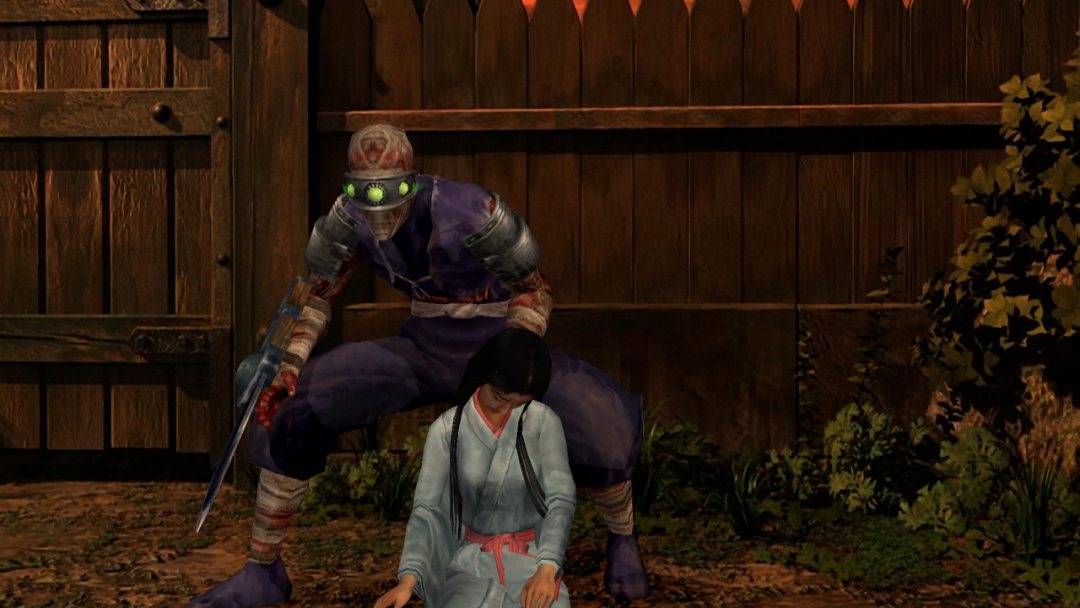
At certain points in the game, control of Samanosuke will shift to his ninja assistant, Kaede. These sections are less about combat and more about simply getting through them, as Kaede is far weaker than Samanosuke in basically every way. She’s quicker than her samurai counterpart, but her short tanto has neither the reach nor the strength to contend with some of the game’s more imposing threats. She does, however, possess a large number of throwable kunai that do a great job at stunning enemies for a brief moment, allowing her to deftly move past them and avoid combat. Kaede does eventually gain access to a more powerful version of her starting weapon, but this comes significantly later in the game.
Kaede’s sections were decent enough, but sometimes it felt like they were trying to emulate Resident Evil’s design a little too closely. You’ll recall if you played Resident Evil 2 how control briefly shifts from protagonist Leon S. Kennedy to Ada Wong about midway through the story of that game. Kaede’s sections could’ve been left out of the game entirely and would not have an impact on my enjoyment of the game either way. At a basic level, however, it is nice when a game shakes things up a bit and changes perspectives by putting us in another person’s shoes (or geta in this case). In future entries, I’d like to see perspective changes done with a bit more variety than simply the game saying “you get to play as this character now!”
Like its predecessor series of Resident Evil, Onimusha: Warlords features a few puzzles over the course of the adventure. Many of these are simply key item hunts or very simple logic puzzles. However, one type of puzzle encountered multiple times over the course of the adventure still gives me fits to this day, known simply as “decoder boxes”. For these puzzles, you’re supposed to locate a document in the surrounding area that supposedly gives you the solution to the puzzle, but for the life of me I struggle with answering these nine times out of ten. Perhaps it’s due to the cockeyed orientation of the user interface (UI) when solving the puzzle. More than likely, however, is the fact that so many of the ancient characters within the coded message look so similar to each other. I am completely unashamed to admit that I will follow along with a YouTube video in order to make sure I get all these puzzles, as some have key items required for progression or resources that you can’t afford to pass up.
Enemies, known in the game as Genma, range from standard zombified warriors armed with little more than rusty katana to absolutely hellish abominations capable of disemboweling Samanosuke at the drop of a kabuto (that’s a “samurai helmet” for you gaijin). There are a wide variety of enemy types found at Inabayama Castle, each with their own attacks and strategies the player needs to take in order to efficiently defeat them. There’s some who are capable of grabbing Samanosuke and inflicting a large chunk of damage upon him. There’s others that are capable of even robbing Samanosuke of a portion of the souls he’s absorbed. One other enemy type can duplicate itself multiple times if Samanosuke knocks it down without killing it. All in all, the variety of enemies is enough to keep the player on their toes with a consistent challenge for the entire duration of the experience.
All these dutifully crafted gameplay components come together wonderfully to give the player a deep interactive experience that has stood the test of time.
Story: 1
In comparison to many of the narrative shotgun blasts we get in a lot of games’ stories today, Onimusha: Warlords keeps it simple. Indeed, because of the simplicity, the story doesn’t insist upon itself or take itself too seriously.
Onimusha: Warlords takes place during the Sengoku period of Japanese history, which literally translates to “Warring States period.” This time in Japanese history consisted of various, continuous uprisings and civil conflicts between the 15th and 17th centuries. The story begins with scenes of a battle, specifically the real-life Battle of Okehazama in June 1560. In real-world history, upstart daimyo Oda Nobunaga took his vastly outnumbered forces to arms against the rapidly advancing, 25,000-strong army of rival samurai lord Imagawa Yoshimoto. Oda clan forces subsequently routed them in what was considered one of the great upsets in Japanese military history. This victory established Oda as one of the most prominent lords within feudal Japanese society at the time. In Onimusha, Oda’s forces win the battle in Okehazama, but Oda is killed immediately upon receiving news of his victory. Despite being slain by a stray arrow, Oda is seen riding on with his retinue of soldiers moments later, ominously unscathed from his fatal wound.
Protagonist Samanosuke Akechi watches the battle and witnesses this miraculous event, though instead of feeling awe, he is more apprehensive of what this might mean. A year after the events at Okehazama, Samanosuke receives a letter from his cousin, the Princess Yuki of Clan Saito, who explains that strange occurrences have begun happening around the castle over the past year. She implores Samanosuke to come to her aid quickly, as she believes demons and monsters are responsible for a string of random violence and kidnappings throughout Inabayama Castle and the surrounding countryside.

By the time Samanosuke reaches the castle, Princess Yuki has been abducted. A few hours after searching the castle grounds, Samanosuke finds the abhorrent beast responsible for Yuki’s kidnapping. He is quickly defeated by the large demon, and Yuki is taken further away. Upon waking up, Samanosuke finds that he has been endowed with the aforementioned oni gauntlet, giving him the strength to defeat the demons. As he fights through the castle’s exterior and reaches the interior, Samanosuke discovers the stronghold has effectively become the headquarters for the demons as they initiate their siege of the human world. Whilst exploring the bowels of the castle, he discovers that Oda made a pact with the demons in exchange for immortality prior to his death and resurrection at Okehazama.
Samanosuke’s quest eventually brings him to the demon world, where he discovers the further latent power residing within him needed to complete his quest and save Princess Yuki.
There, I’ve given you more than enough to chew on for the story, so why not just go out and buy it to see the rest for yourself. All in all, it’s not exactly Inception, but the plot is more than enough for players to get invested in both the story and the characters.
Atmosphere: 1
As good as Capcom is at honing a great atmosphere in games new and old, there’s a little something lacking here. The music, however, is epic. If I had to describe it in one word: cinematic. This might seem like a cliche descriptor in this day and age, but at the time in 2001, games weren’t known for universally being on par with cinematic experiences. Through Onimusha’s score, there are moments where you feel as if you’re doing more than playing a game. The score actually makes the player feel like they themselves are in this tense and perilous situation, better than many other releases of the time. The score ranges from that of traditional Japanese instrumental riffs to a 200-piece orchestra that gives us compositions on par with Joe Hisaishi of Studio Ghibli fame.
Apart from the music, however, many of the set pieces are just… lacking. These bland environments are especially nagging considering how good Capcom’s atmosphere looks and feels in other contemporaries to Onimusha like Devil May Cry or Resident Evil 2 and 3. Every now and then, you’ll come across a mangled body within one of the game’s pre-rendered backgrounds, or perhaps some other signs of carnage and destruction, though the environment doesn’t really have a lot that sticks out to me in the end. There are some cool rooms here and there. These are few and far between, and they don’t compensate for the overall lack of variety.
Inabayama Castle was designed as a Sengoku Era analogue to Resident Evil’s Spencer Mansion. As the poet Lil Wayne once said, “If it ain’t broke, don’t break it.” I think by the time 2001 came around, however, the Spencer Mansion layout had already been done to near death.
This layout was first featured in the original Resident Evil in 1996. In 1998, the Raccoon City Police Department featured a similar design in Resident Evil 2 and 3. Devil May Cry’s first large room shares this layout too. Furthermore, Resident Evil Remake, Resident Evil 0 and Clock Tower 3 all released a year after Onimusha: Warlords in 2002 all feature similar designs to the mansion in certain areas of their gameplay. I’ll admit, the Spencer Mansion was a masterclass in how to create a giant puzzle box disguised as a spooky house, but I would’ve liked to have seen Capcom innovate a tad bit more.
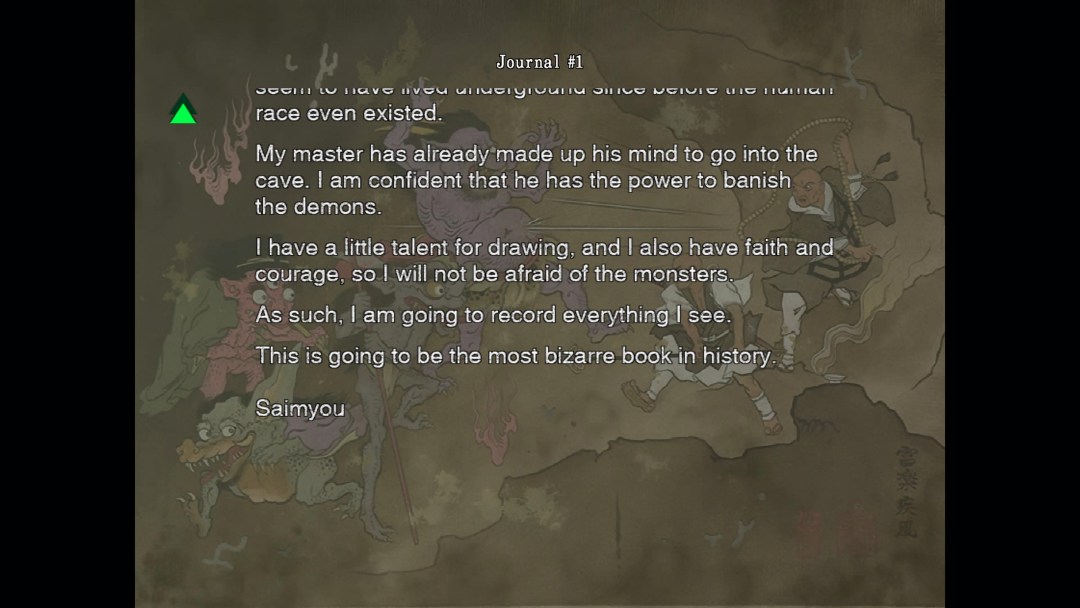
Some of the documents found in the game world are (still, even with a remaster) poorly localized and translated, making them more comedic upon reading them than interesting or foreboding. One such file found in the game comes very shortly after starting a new game.
One section of the file, known as “Saimyou’s Journal 1”, reads like this:
I have a little talent for drawing, and I also have faith and courage, so I will not be afraid of the monsters.
As such, I am going to record everything I see.
This is going to be the most bizarre book in history
-Saimyou
Okay, it’s not exactly packed with typos and grammatical errors, and this might just be me, but I just can’t help but chuckle when I read this. It’s just awkward. Admittedly, with how poorly some voice acting was during the late 90s and early 2000s it would’ve been a lot worse if this was voiced instead of read. There’s something about this and some of the other files found in the game that are just a little bit ‘off,’ which subtracts from the achievements of other parts of the atmosphere.
One way the atmosphere claws back to a one is the casting of Samanosuke’s Japanese language voice actor, motion capture, and character model, Takeshi Kaneshiro. Kaneshiro’s involvement in the game elevated Onimusha: Warlords from being just another cool action-adventure title to a testament to the increased capabilities these newer consoles had at the time. Kaneshiro was and still is a superstar in the Asian entertainment industry, and his involvement in the game took Onimusha: Warlords to even further heights. Not only was he every aspect of the character of Samanosuke, but he also served as a producer on the game as well. This meant Kaneshiro, as a mind from film and television, was able to bridge the gap that existed between these differing forms of media for one of the first times in history.
For western audiences who might not have been familiar with Kaneshiro, they at least saw the capabilities of putting a real person’s face into a fully rendered model for one of the first times in gaming history, a sign of great things in the years to come. Today, blockbuster Hollywood actors are practically a commonality in videogames. Due to the power of hardware and software today, more and more household names from film and TV are able to indistinguishably have their likeness placed onto character models. Games like Death Stranding and Alan Wake 2 are just a small selection of games where this technology is employed to the ultimate degree. Onimusha: Warlords was a game at the forefront of this technology, and we owe it to Capcom and their staff for their consequential contributions to the art form.
Value: 2
At $19.99, this game was a steal 15 years ago. This is an incredible experience that will not break the bank. While the original console version might cost you a pretty penny on eBay or other sites, the wholly accessible remaster available on contemporary platforms is well worth the price and then some. The value of the remaster is even more considerable, especially when taking into account the exponential graphical upgrade compared to the original.
Duration: 2
Though the completion of the campaign only takes about five to seven hours to complete, there is plenty of content upon beating your first playthrough that is unlocked. Higher difficulty levels and a series of challenge rooms to test your might against an onslaught of Genma add to the runtime. Shorter games shouldn’t always be docked points, in my opinion. As more and more games take 40, 50, 60+ hours to complete, it’s kind of refreshing to have a game that you can pick up, play, enjoy, and beat in the span of an afternoon.
Total Score: 8/10
All in all, Onimusha: Warlords is a crowning achievement for both Capcom and the videogame industry in general. From the innovative motion capture to the epic soundtrack to the slick gameplay, this is a game that all gamers should try. Even if you aren’t a fan of these games, try this one if only in appreciation for its contributions to the industry. It’s a fun experience that doesn’t take too long to beat, and it’s very easy to familiarize yourself with the gameplay loop and controls. When many modern titles fall short in a number of ways, it’s nice to go back to a time when games were labors of love and, more importantly, finished products upon release.
So, what did you think of Onimusha: Warlords? Does it stand the test of time as I claim? Or am I just another oldhead reminiscing about a world that once was, or perhaps a world that never was?

By Houston Vick





 Off the Shelf Media
Leave a reply to (Re)-Enter the Samurai Survival Horror: Onimusha 2: Samurai’s Destiny Review – Off the Shelf Media Cancel reply