
Genre: First-person Shooter (FPS), Action
Developer: Valve Corporation
Publisher: Valve Corporation
Release Date: November 19, 2018
Players: Single-Player, Online Player versus Player (PvP)
Review Date: March 15, 2026
Format: PC
Playtime (To Date): 11.8 hours
MSRP (To Date): $9.99
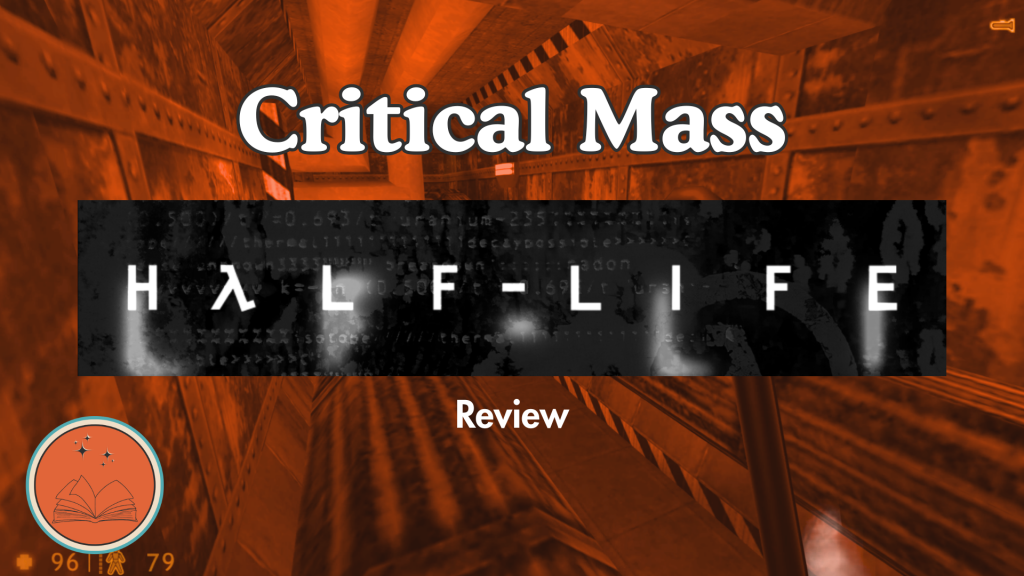
One of the most important games ever released, Half-Life was the first game released by Valve Corporation in 1998. Today, the company is equally affiliated with Steam, a game platform that is the most widely used platform for distributing PC games, along with many other free services such as discussion boards, voice and video chat, and a player-centered marketplace for in-game rewards (there are many other features Steam offers, but those are the most used in my experience).
In recent years, Steam has averaged around forty million monthly users; what started as a simple game idea has defined the market and industry. A player outside the ring of the console wars that may soon be its undoing, but has undeniably been able to shake the entire foundation of the industry.
The simple idea behind Half-Life was to offer something different from the current market when it came to FPS titles. It was the era of Doom Clones that had become stagnant due to its constant use of the same game theory. The changes Valve made in comparison to titles around the same time not only changed gameplay but also narrative elements that reshaped how immersive a game could be.
Gameplay: 2
Based on the Quake I and II engines, Valve reworked them into the perfect system for their own designs. That means the game is fast-paced with countless options for gunplay to face the different enemy types players encounter. You certainly can try and play it slow, but as the enemies slowly increase in difficulty with story progression, it saves a lot of time and is far more fun to outmaneuver them. It gives you just enough time to test and familiarize yourself with new weapons before that mastery can really be put into practice.

Another major feature that was not as common at the time is being able to save anywhere. Nowadays, such a small feature can be taken for granted and is still uncommon in FPS titles that are more current, which often rely on checkpoints. It means you can easily mark your progress at your discretion, which is incredibly important. I found myself often loading, not because I could not clear enemies in a certain section, but because I was inefficient and had much less ammo or health needed to comfortably progress.
The game also rewards exploration. There is often more than one hallway to take or path before the player, even if that path might be hidden in an air duct. You can easily miss certain weapons and other caches of ammo or health items without the use of a careful eye.
I was able to play this game on a modern system without any tweaking or additional software outside of the Steam launcher. It is a fairly impressive feat considering how old the game is; it is just as, if not easier, to launch now than on release. It also means almost every system can handle it, and if yours can’t, well, it might be time to upgrade from that Commodore 64.

Because the core gameplay is perfect, it has a transcendent application. Advice I often give to people playing FPS games, who want to improve their skill outside of the highly competitive new releases, is to play older titles that are still in line with the general game theory of their current counterparts. Halo 1-3 have been a prime example and a go-to suggestion. They still have fairly consistent lobbies, but the campaigns also have intelligent and difficult enough pathfinding to hone your skills. The slower movement and higher health per player are more in line with games like Battlefield. By no means are they the same, but the heavy movement and timing certainly help to calculate things like when to use grenades, dodge, and useful shooting windows. The Halo series is much simpler, so the controls and weapons are easier to understand. It takes far less to familiarize oneself with its system. Thus, by getting better at those games, one can easily transfer the vast majority of that skill set to FPS titles that also have heavier movement and sturdier targets.

Half-Life has the same use case. The major difference is the types of modern games that would be the most useful. Games more similar to the Call of Duty franchise and maybe even the newly released Marathon. The rapid pace and unique weapon types allow a certain amount of freedom to dispatch enemies but in a far easier package to master without the need for high-intensity lobbies of those titles on release.
Story: 2
You play as Gordon Freeman, surviving after an experiment gone wrong in the Black Mesa Research Facility. In the aftermath of the experiment, you start off with nothing more than a crowbar and gather what you can to fight your way through aliens and some more familiar enemies in an attempt to escape or, at the very least, survive.

At the time of its release, the graphics were stunning, and the interactive environment was nothing short of impressive. The setting was intended to be a horror game, and while that description was most likely accurate on release, those pixels are less intimidating now, only by comparison.
It still plays like a sci-fi epic, and the design throughout the levels is perfectly fitted. Nothing feels out of place, even if the surroundings are entirely unfamiliar. Designer Brett Johnson noted that much of the level design was inspired by the manga series Akira, which I only mention because I get the same feeling every time I see a large platform inclined elevator.

Atmosphere: 2
Most games at the time were separated using levels and cutscenes to divide them. These points of separation, while logical, have a recurring effect of pulling a player outside of the environment the character is in. Half-Life uses chapters that act as automatic checkpoints and only appear on screen for a moment. The player never sees the main character they control. As a result, the game is entirely engulfing. It is easy to find the hours melt away while playing with little put on the screen.
It also plays into the story. You are not an epic hero or renowned star traveler, just a man caught in the midst of a terrible time. By the end, there is an equal sense of relief and accomplishment. I ended the game with seven health left. Even if the fight was epic, the countless reloaded saves show the price to win. By eliminating cutscenes and exclusively using in-game animations, it all feels real, even so many years later, with many fewer rounded edges compared to modern graphics. The music and sound effects also do a great job of sustaining that environment, but the act of not removing the player from Gordon’s perspective is master class storytelling.

Value: 2
It’s under $10, just buy it. If nothing for nostalgia, it’s still worth every penny. It comes with two different DLCs: Blue Shift and Opposing Force. They take players on a similar journey, but this time as a security guard and a marine, respectively. Incredibly unique decision on its own and fully worth the price.
Duration: 1
Every part of the game is good, which is what makes this section difficult to score. The game does not feel long for the vast majority of it, except for the end. I would rather not spoil anything, even though the game is 28 years old.
Nothing about it was spoiled for me, so I think it’s best to try and respect that. It felt like the last ‘stage’ of the game had so many parts thrust upon the player that it felt overwhelming. Not to suggest it should be made easier, but rather, it probably should have had another section inserted to familiarize the new mechanics just a bit longer. You can expect to finish your first playthrough around 14 hours, so it’s a bit low on our cost-to-playable-hours scale ($1=1 hour of gameplay). That being said, nothing is incredibly frustrating if you go into it anticipating some puzzle-solving.

Total Score: 9/10
The biggest takeaway is how good this game scores with contemporary titles around it. It completely holds up and is better than so many recent titles. The design and technology used to make the game have lasted and have probably had one of the most impactful effects on the industry in terms of what to expect from realism. Nothing is tedious, and the physical effect on the environment might not win awards in 2026, but it manages to keep the game as a worthy title to this day.

By Nash Moorer

Leave a Reply