
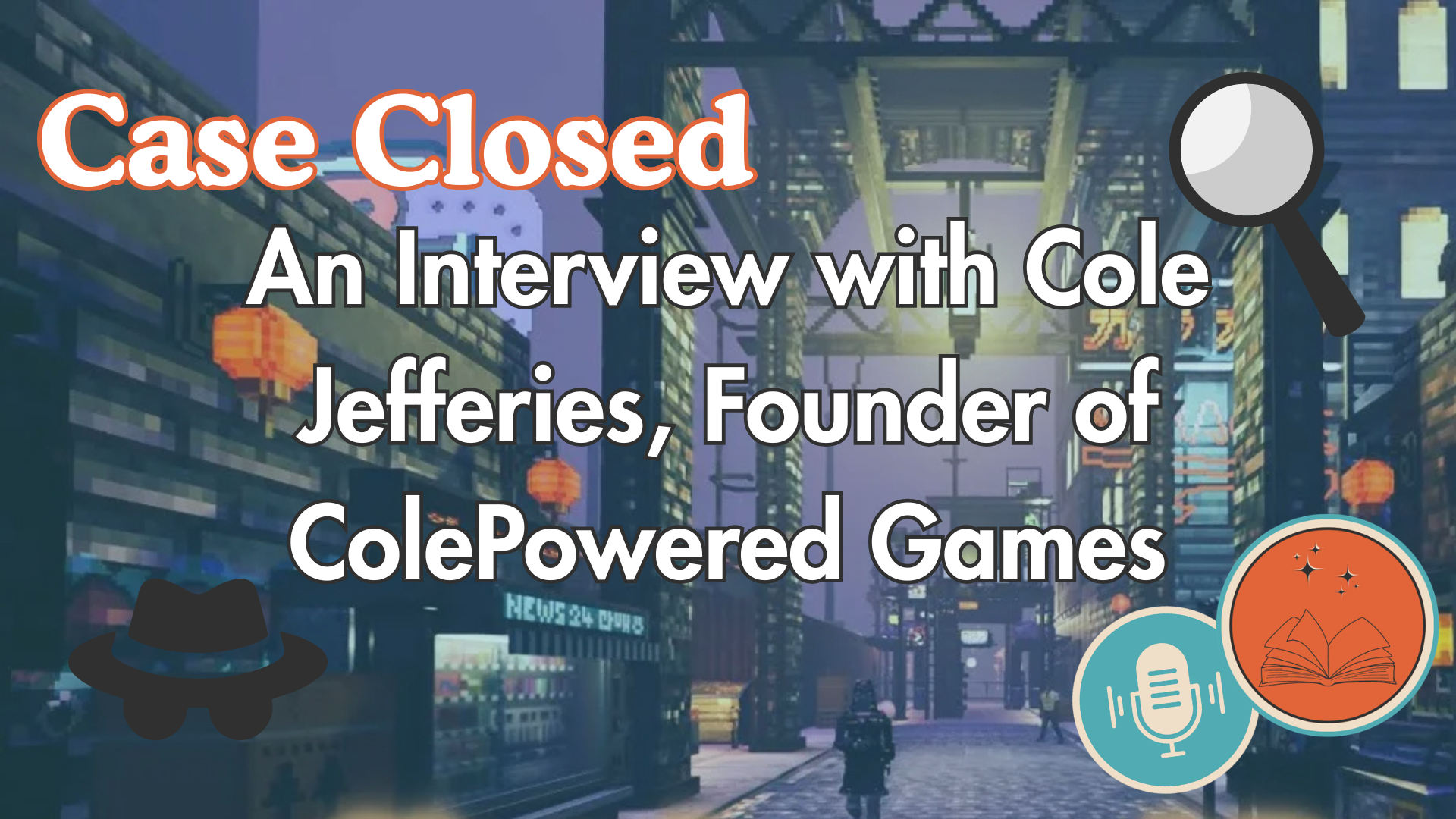
Two years ago, we reviewed Shadows of Doubt, and it impressed us enough to make a beginner’s guide, which you can find on our YouTube as well as a more in-depth version on our website. While other sleuthing titles exist, Shadows of Doubt utilizes unique procedural generation as well as offering many forms of customization for players.
It is the epitome of everything done right with an indie title. The unique concept and game theory work well in the simple yet dramatic voxel design. The constant hunt for information and character design of non-player characters (NPCs) makes it feel like a living world. It perfects the little things, and the players are left to wade through the motion with the ever-looming threat of another crime always on the horizon.

Since our review, Cole Jefferies (@colejefferies), the founder of ColePowered, the studio that developed Shadows of Doubt, has stayed busy adding even more content. Three major updates, Off-Duty, Modifiers, and Steam-Workshop compatibility, have expanded the game and made it easier for players to add their own content. It does not just stop there. We were lucky enough to interview Mr. Jefferies recently and learn a little bit about Shadows of Doubt and its design.
Was there a particular videogame that first sparked your interest in becoming a game developer?
Not any single game, but generally if I really enjoy something (especially something experiential), I want to explore and make my own take on it. During my teenage years, I loved video games, and PC games in particular, so naturally I wanted to make my own as soon as I could understand how. Back in the 90s and early 00s, the development software was somewhat more limited, so I started making simple games using The Games Factory and Clickteam Fusion, which were fantastic beginner tools with a thriving community of indie game devs. The games that kick-started my very first attempts at development were titles such as Command & Conquer, Command & Conquer: Red Alert, Worms, Age of Empires, SimCity, etc. Basically, all the classics. I wanted to make everything!
Back then, this was very much a hobby thing; indie games didn’t exist in a proper industry space that could viably generate money (with some but very few exceptions). It wasn’t until the late 00s and early 2010s that the indie scene became its own industry niche, and the idea of making a living from smaller projects became feasible. So, that’s the point where I gave it a proper shot.
What was the inspiration behind Shadows of Doubt? Was there a specific moment that sparked the idea, or did it come together gradually over time?
For inspiration, definitely games from the immersive sim genre, such as Deus Ex, Thief and Dishonoured for the gameplay where you can take different approaches towards the same goal. But also, the tabletop game Sherlock Holmes: Consulting Detective was a huge influence: I wanted to make something open-ended and entirely driven by player decisions. Consulting Detective has that approach and gives you a broad range of possible interactions, but by also using that approach in a digital game, we were able to expand those possibilities even further. In Shadows of Doubt, for example, you can investigate CCTV, fingerprints, footprints, telephones, etc., for even more branching investigation possibilities.

As to how it came together, mostly the latter but a bit of both: I started the project that became Shadows of Doubt knowing basically two things: I wanted to create a simulation-driven emergent experience, and that experience would involve solving detective cases in some fashion. Originally, the project was to be an isometric management game where you managed a detective agency. As the project grew and I started to experiment with and implement the proc-gen simulated world and citizens, I realised the isometric camera felt too divorced from the action and intrigue of what was happening in the game world.
One day, I switched from the overhead isometric camera to first-person and gave the player the ability to walk around. From there, everything started to really click and what Shadows of Doubt eventually became really fell into place.
Looking back on the development process for Shadows of Doubt, what surprised you most while building the game? What has been the most shocking since its release?
There are surprises just about everywhere! The biggest one is perhaps how many people resonated with the core concept, to the point where sometimes I wish we had the capacity to push the game more into the more polished triple-I space, where we have a couple of dozen people working on it as opposed to just a few of us. That brings its own challenges, though, and there are advantages to staying small…

The behaviour AI (as in citizen AI, not generative/LLM AI, which we don’t use) was possibly the biggest challenge of the whole project, and it’s still something we’re working to improve. The challenge is having two layers of behaviour work simultaneously; the system of having them perform their daily route (go to work, get food, go to bed, etc.) and also having the expected stealth behaviour that reacts to you and others if they detect something strange or out of place. Those two systems often fight against each other a bit. There’s also a challenge with mission scripting, as relying on citizens to be present at a specific place is difficult, as their behaviour is designed to be free-form.
One of the more intriguing design choices in the game is the existence of guns for non-player characters (NPCs), yet players themselves are unable to use them. What led you to this decision? How did you determine the role combat would have in the game?
There are three main reasons we’re not super keen on the idea of the player shooting or killing anyone in-game. The first reason is that, from a design perspective, reducing the population of the city by killing them off is not a problem we wanted to contend with! How hard the game can be is somewhat linked to the city’s population. So want to make the next case easier? Why not reduce the population of the city by killing them!? We would give an organic incentive to kill. Secondly is the (and I will use a bit of a cliche game designer term here) ludonarrative dissonance created when we have the player as a detective trying to solve a murder while also killing off people. The third reason is that stealth is more intense, interesting and rewarding when your plan B isn’t just shoot everyone. The world needs to be intimidating for a lot of Shadows’ mechanics to be effective.
None of the problems mentioned here are insurmountable, and it’s something that should be evaluated and redesigned around, should we do another Shadows game.
Shadows of Doubt features an immersive, voxel design. What drew you to this design, and how does it add to the atmosphere of the game?
Voxels were a stylistic choice early in the project to begin with, but they also made sense to use practically. As this was an ambitious project for a small team like us, we needed an art style where we could produce a lot of models in a relatively short amount of time and working with voxels provides that. It’s a bit like building with LEGO! We were able to combine this aesthetic with some moody high-definition lighting to provide what you see in the game today. We’re really proud of the final result.

We wanted to create a deep noir atmosphere, and that’s something that both Nick Dymond (audio) and I were really passionate about. We both spent a long time on things like getting the rain feeling right, for example, and invested a lot of attention to detail in this, like putting in the sound of water dripping off buildings as you get close to the street edges, etc. We think it really helps go a long way to immerse the player in the world.
Both Shadows of Doubt and Concrete Jungle feature card game elements. Are there any in particular that stand out for you, or are you a fan of that style of game as a whole?
I love the deck-building genre, and it’s awesome to see how it’s developed since I put out Concrete Jungle in 2015 with games like Slay the Spire, Balatro, etc. Those two are my biggest time sinks, and StS 2 especially is something I feel like I can play forever for the rest of my life without getting bored. That’s an incredible achievement from a design perspective, and for me, it features just the right amount of randomness and player agency to hit the sweetest spot possible. At its core, I love the way the decision-making is distilled down to a handful of options at any given point, but there’s still a huge amount of strategy present within those decisions.
With the recent addition of Steam Workshop functionality, what can players expect to see from future updates or DLC for Shadows of Doubt?
Mod support for the game has been tricky for technical reasons, but we’ve tried our best throughout to enable our wonderful mod community. With my background in 90s/00s PC gaming, I’ve always loved mods and the amazing things they create, so naturally, I always want to enable modders to mod our games. The way Shadows was developed and evolved made it a bit tricky to enable this as well as I would have hoped, but we’ve at least covered some ground with the latest workshop update.
Players can write custom dialogue for the game and create their own interactions within generated cities, and then share their work using Steam Workshop or mod.io. More advanced modding techniques exist for more complex mods, but I would encourage anyone interested in them to visit the modding section on our Discord for more info.

As for future updates, we’re switching focus to fixes and polish, along with quality of life improvements as opposed to content. With so many interconnected systems, new content becomes more of a challenge to implement and often breaks something else we’ve previously worked hard to implement or balance. At this stage in the game’s development, we’re more interested in upgrading the experience as opposed to endlessly adding to it (but that’s not to say there definitely won’t be the occasional new thing either!)
What advice would you give other indie developers or individuals curious about becoming a developer but not knowing where to begin?
Motivation is the most important thing! If you’re motivated and learn what it takes to achieve the thing you’re passionate about, then it’s only a matter of time and effort before you achieve it. It’s important to make sure your desires are based on the love of game development itself rather than a desire for financial gain (because that is not easy!) Hopefully, that will follow eventually, but there will be a lot of hard work first. Game dev is a labour of love, and there are no shortcuts to success.
Finally, can you give us a hint at what new projects you may be working on or concepts you have been thinking about for your next project?
There’s not much I can reveal, but alongside continuing to patch and update Shadow of Doubt, we’re working on three core things: One big project, one small (er) project and then one thing where we don’t even know if it will work or how feasible it is at this stage! That’s a bit cryptic, but we don’t want to talk about or hype things too early, so that’s all I will say. Besides, it’s more fun to let people deduce stuff!
Being able to see the dedication from the ColePowered team adds even more value to the title and keeps them on our radar for the future. If you want to stay in touch with them, be sure to check out their website as they intend to relaunch their development blog as well as dev log videos. You can also follow ColePowered on Instagram, YouTube and Bluesky for more.

By Nash Moorer

Leave a Reply