
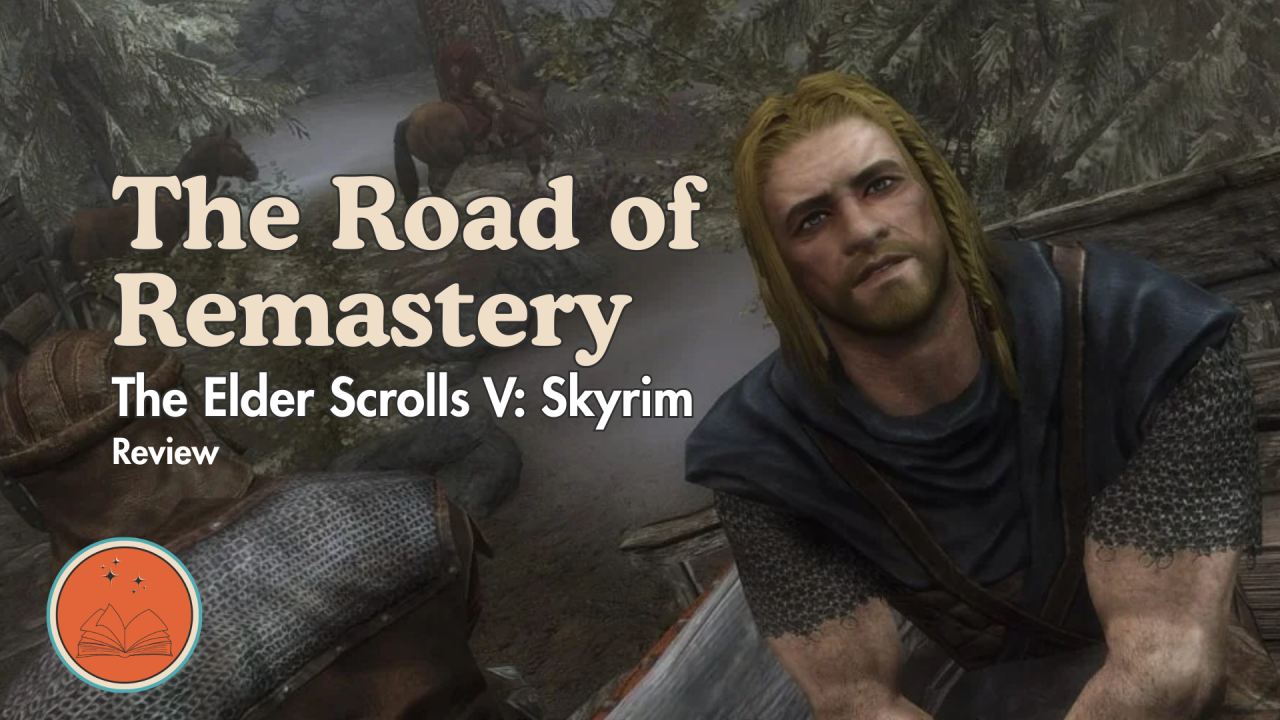
Genre: Role-playing Game (RPG)
Developer: Bethesda Game Studios
Publisher: Bethesda Softworks
Release Date: November 11, 2011
Players: Single-Player
Review Date: July 21, 2026
Format: PC, PlayStation, Xbox, Switch
Playtime (To Date): 1,000+ hours
MSRP (To Date): $19.99 (Standard Edition), $39.99 (Special Edition)
The Elder Scrolls franchise is my favorite game series. While that statement obviously drips with biases, it is for good reason. Each game, upon release, becomes genre-defining. Whether you love or hate these games, it is impossible to ignore that they are the absolute gold standard for open-world RPGs.
Throughout gaming history, there have been many titles that shake up the development world. The Elder Scrolls V: Skyrim set a new benchmark for open-world design. Even while not being the largest game map in the franchise, it was certainly the most dense and dynamic. Its release generates a sense of awe as each title manages to surpass the perfection established by the last; it becomes hard to believe the next will be able to do the same again.
It’s no surprise then that the release of Elder Scrolls VI is surrounded by so much anticipation that is only increased more with the passage of time.
The bar has been set so high because of the incredible standard Bethesda itself created. Skyrim, in particular, opened that door to a massive audience that proved how successful expansive single-player open worlds can be. It continues to average 30,000 or more players daily and still ranks as one of the highest-selling single-player exclusive games of all time.
Games that were released in the wake, such as The Witcher 3: Wild Hunt and Elden Ring, generated roughly the same sales of around 60 million copies in large part due to the cultural dominance Skyrim garnered. They are still nerdy games, but that seems to matter less because of how well they were made; Skyrim kicked that door open and ensured it stayed open.

Gameplay: 2
Typically, RPGs have a somewhat rigid character design parameter. This is not in reference to cosmetic features, but how you determine leveling as you continue to play, usually defined by character traits or skills that are selected early on. This feature can pose as an emerging problem for gameplay.
If it is the first playthrough, players really do not have a sense as to what skills will be the most useful or even if they will enjoy the mechanics surrounding their selection. Take, for instance, how magic is used between The Elder Scrolls IV: Oblivion and Skyrim.
In Oblivion, spells are selected and used from a hotkey slot; the spells are never actually wielded in the hand. From the jump, it makes them feel more like supplemental attacks or buffs rather than using them as a primary attack. It’s similar to previous games, but it could affect how much enjoyment someone might get, assuming the opposite without the experience to make an accurate judgment.
Skyrim took that concept and turned it on its head. Yes, players can make selections in character creation that offer skill advantages, but it does not restrict players from deciding to learn other skills just as easily by simply using them. There is no negative outcome from picking a melee combat build early and then deciding to focus on archery.

It means the level cap is nonexistent or, more importantly, irrelevant because players can choose to train any skill they want at any time without a diminished rate. You might start at level five versus level 15, but that is the only major difference, and it is temporary. Where older RPGs handle character creation as a backstory to lock players into a specific type of build, Skyrim uses it more as assurance that players can manage the beginning of the game and adapt as they discover and play more.
Combining the combat style of their previous games while also introducing more practical control for your off-hand gave players a more immersive feeling. Players can equip a sword and shield or just as easily a sword in one hand and a spell in the other. This transition, combined with more weighted attacks, adds more realism and makes each fight have more power behind it. This is all due to the new game engine they designed for Skyrim, called the Creation Engine. It is becoming rarer to see developers making their own engine and using Unreal Engine and Unity.
As proven stable platforms that allow for massive amounts of manipulation and at-hand assets, they tend to make more financial sense. If you have started to feel that games are looking incredibly similar, you’re not crazy; you’ve just stumbled upon a more common developer and market trend. But these engines have their limitations and can make games feel repetitive across multiple titles. The creation engine was designed to handle the massive environments, complex AI, and physics specifically for Skyrim’s RPG style and adds to the massive success by making every interaction feel so tied into the game’s world.

I’m sure at some point those familiar with the game are anticipating my comments on the glitches within the game. It is true, Skyrim does have bugs that have become the focus of countless memes and complaints. For such a massive game, it is seemingly unavoidable. However, in my experience, with more than 1000 hours of gameplay, I felt like those minor issues became the thing to make fun of rather than actual issues. In my total time playing, I only experienced one instance of a game-breaking glitch that required me to restart an old save. That is a rare experience compared to Oblivion, including the remaster, and even The Elder Scrolls III: Morrowind. It is also important to note I played this game using the Xbox One and now across three different PCs and the Nintendo Switch.
At the time of launch, Bethesda had 100 employees working to make Skyrim. Compared to the 1,000 global employees Rockstar had at the release of Grand Theft Auto V. I bring it up because in the barely over 200 hours I have played on GTA V, I experienced far more crashes, lost cinematic animations, corrupted saves, and missing mission triggers. That is nothing to say of the issues from hackers that the online community constantly deals with. Yet, that game does not follow the same reputation. I think the hyperbole stems from the issues that players might face in Skyrim, which usually aren’t game-breaking but funny compared to the GTA V ones that destroy an entire playthrough. Still, I never described that game as a broken mess but understood it is a massive production, and everything wouldn’t be flawless.

It is such a difficult undertaking when you try to figure out the total possible options and scripted events a player has in a completely open world. No game does it better than Skyrim. Very few locations and quests are locked behind the story but rather use leveling and the player’s previous actions to organically introduce new quests, literally, while also offering the countless number of quests players can seek out. Yes, couriers and Meridia’s Beacon can pull you out, but they are such a tiny percentage of the total available options, plus the ability to dungeon crawl without any quests makes those blips nearly insignificant.

It takes everything an RPG should have and combines it with total freedom. It retains enough structure to make a direction easy to follow, so that players will always have plenty of options for missions without feeling bored. It also handles late game incredibly well. A hallmark of the franchise is the ability to use magic to absolutely break the game and make your player ultimately invincible without console commands and instead with built-in features. It leaves that endgame supremacy up to the player to exploit or not. While there may be methods to achieve it early on, it feels reasonable to take advantage of those systems near the endgame because of the massive list of accomplishments your player accumulates.

Story: 2
The story saw a massive improvement as well. Bethesda is known for their long main story missions that drive players to the heart of the lore for the region in which the game takes place. It keeps the games fresh and relevant, not just stylistically but thematically, to the world and time of the game. My biggest complaint with Oblivion’s story, while it was and remains incredible writing, the player felt like Martin’s errand boy rather than the central figure. My one complaint with Skyrim is that I wish the main story were longer, at least when I first played.

Over the years, I have grown not to mind it. That is because the game has so many total stories and long questlines that the main story only feels short because of how many other mission lines are present. Every playthrough, I discover something new. I have not played in around three years, mainly because I worry I might have discovered everything, but I’m certain that when I pick it up again, I will prove myself wrong, as I have every time before.

My advice is, while the main story is captivating and epic, it’s important to smell the nirnroot along the journey. Not only does it make each playthrough feel dynamic, but players might also discover consequences and storylines they did not know existed.
Atmosphere: 2
All great games manage to combine or allow the atmosphere to blend with gameplay. Skyrim achieves this at every chance. One major improvement and distinction was the change in menu layout.
Skyrim is sleek and seamless. It is easy to navigate between your items and spells, and looking at your skills brings the camera to the heavens to show the star signs that are attributed to your respective skills. The map also draws the camera to the sky to show the nation’s landscape and environment as if from the viewpoint of a satellite. It was a step away from the spreadsheet design that has become synonymous with RPG titles, and one that took a static feature and made it dynamic.

It is also part of the map design. Almost every single cave is designed to loop back to the beginning behind a hidden door only accessible after completing the final chamber. This is a huge distinction. It ensures that most of your playtime is actually spent playing the game and not backtracking just to leave a cave or point of interest.
The game also does not have cinematic cutscenes; instead, non-player characters (NPCs) might have scripted actions during dialogue. It’s another feature that keeps the entire game in real time. The music will also change when entering combat or specific regions. It can be helpful to let players know a random dragon is overhead before they might see it. It is a nudge to get you ready for something epic without putting forced cover in front of you.

These features blend together to keep the player enthralled with the game as much as possible. The mechanics and design are intended to keep the player immersed the entire time. Even when these events do not follow through perfectly, the combined effect of them does not remove players from the game or draw attention to the issue; instead, it becomes another part of the world.
Value: 2
It’s worth it. The DLC is also incredible. My biggest complaint with the game comes from the DLC, but it is minor. To craft arrows, players have to own the Hearthfire DLC, which should have been included as an update in the base game. All the DLCs are included in the most recent edition of the game, of which there have been many, with the most recent feeling like an unnecessary edition.
Bethesda included several mods in that edition that feel like they never went through quality control. Some are casual and not that big of a deal, but some are immersion-breaking and give a bad sense of the game if you have never played it before. My advice is to play without any DLC enabled first, and then on a second playthrough, activate it.

That being said, players are getting a massively updated version of one of the greatest games ever made at less than full price for the base game alone.
Duration: 2
Playthroughs do not have to be 1,000 hours either. Players can probably complete the main story in around ten hours if they focus on nothing else. It certainly is not the best way to play the game, but for those looking to just finish the game, that is certainly a reasonable timeframe, and it will be time enjoyed.

Total Score: 10/10
Skyrim is one of the greatest games ever made. It is unapologetically itself having taken notice of the critiques of its previous titles and offered improvements along with innovations only the studio could have made.
With all the great features and design implemented, I have spent no time talking about the modding community. The already incredible game is host of the most dedicated modders who offer every type of alteration imaginable. Perhaps you want more trees across the country, or armor types from previous games. Maybe you want a dialogue to change the voices of those familiar NPCs, or maybe you want dragons to be Thomas the Tank Engine. The possibilities are endless and range from audio overhauls to changing mechanics.

Skyrim is not just an incredible game; it’s the greatest game ever made and only cares about the player’s experience.

By Nash Moorer


Leave a Reply